
close
Choose Your Site
Global
Social Media


Views: 0 Author: Site Editor Publish Time: 2026-07-10 Origin: Site


Choosing between metallized film and aluminum foil lamination is one of the most consequential decisions in flexible packaging design, with direct impact on product shelf life, material cost, recyclability, and converting throughput. Both options deliver high-barrier performance suitable for oxygen- and moisture-sensitive products, but they differ by an order of magnitude in aluminum thickness, by 40 to 60 percent in material cost, and by a complete reversal in recyclability profile. The right choice depends on the product's barrier requirements, the regulatory environment, the converter's equipment, and the brand's sustainability commitments.
Metallized films — including MPET, MPE, MCPP, and MOPP — use vacuum-deposited aluminum layers 30 to 80 nanometers thick, applied to a polymer substrate in a PVD (physical vapor deposition) chamber. Aluminum foil laminates use solid aluminum foil typically 7 to 9 microns thick, sandwiched between polymer layers via adhesive lamination. The 100x difference in aluminum thickness drives most of the cost, weight, processing, and recyclability differences between the two options.
At Hangzhou VWIN Technology, both metallized films and aluminum foil-based packaging materials are produced under the same quality system, allowing B2B converters to qualify and source both options from a single supplier. The company's Printed Two-Sided Aluminum Foil Woven for Insulated Radiant Barrier and Fire-Resistant Antiglare Double Aluminum Foil Woven for Roof Insulation Materials demonstrate the use of aluminum foil in industrial applications, while MPET, MPE, MCPP, and MOPP films cover the flexible packaging side of the portfolio.
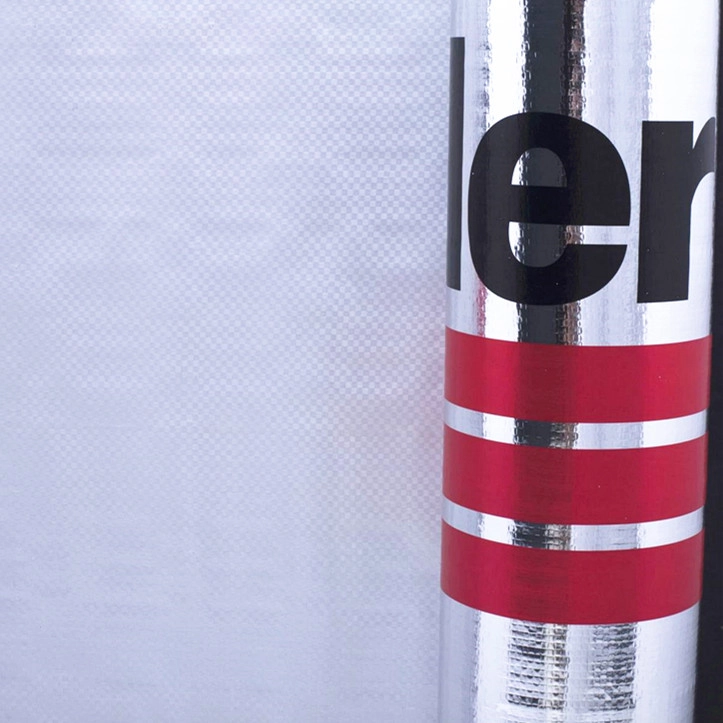
Metallized film is a polymer substrate (PET, PE, CPP, or OPP) with a thin layer of aluminum vacuum-deposited on one side. The aluminum is 30 to 80 nanometers thick — about 1/100th the thickness of a human hair — and is applied in a high-vacuum chamber by resistively heating aluminum wire to vapor, which then condenses on the chilled film surface. The resulting metallized film has the appearance of foil (silvery, reflective) and delivers similar barrier performance for most applications, but at much lower cost and weight.
The four main product families differ by base substrate:
• MPET (BOPET base) — high temperature resistance, dimensional stability, workhorse for snack and dry food packaging
• MPE (PE base) — flexibility, low temperature sealability, used in building insulation and cold chain
• MCPP (CPP base) — heat-sealable, used in retort pouches and food-contact laminations
• MOPP (OPP base) — high gloss, stiffness, used in labels and premium packaging
All four share the same vacuum metallization process, but differ in substrate properties that make them suitable for different end uses.
Aluminum foil lamination uses solid aluminum foil, typically 7 to 9 microns thick for packaging applications, sandwiched between two or more polymer layers. The foil provides the barrier, while the polymer layers (typically PET outer, PE or CPP inner) provide mechanical strength, printability, and heat-sealability. The structure PET/AL/PE is the classic foil-based high-barrier laminate, used for pharmaceutical blister packs, retort pouches, and long-shelf-life ready meals.
Aluminum foil has been the gold standard for high-barrier packaging for more than 70 years, with a track record in military rations, pharmaceutical products, and ultra-long-shelf-life food. Its barrier performance is unmatched by any single-layer polymer film and is typically used as the benchmark for "ultimate barrier" in packaging specifications.
OTR is the key barrier metric for oxygen-sensitive products (coffee, nuts, dried fruit, vitamins, pharmaceutical). Lower is better. A 12 micron MPET delivers OTR below 1 cc/m²/day at 23 degrees Celsius and 50 percent RH, while a 7 micron aluminum foil laminate delivers OTR below 0.05 cc/m²/day under the same conditions. The foil delivers 10 to 20x better oxygen barrier than metallized film.
For most snack, confectionery, and dry food applications, MPET's 1 cc/m²/day OTR is more than sufficient — the limiting factor is usually the heat-seal layer and the package geometry, not the metallized layer. For pharmaceutical blister packs, retort pouches, and products requiring 24+ months of shelf life, the additional barrier of foil is required.
WVTR is the key barrier metric for moisture-sensitive products (crackers, dried fruit, powdered milk). Lower is better. MPET delivers WVTR below 0.5 g/m²/day at 38 degrees Celsius and 90 percent RH, while aluminum foil laminates deliver WVTR below 0.05 g/m²/day under the same conditions. The WVTR advantage of foil is even larger than its OTR advantage.
For moisture-sensitive products with extended shelf life requirements, aluminum foil lamination remains the gold standard. For products with shorter shelf life (6 to 12 months) or with secondary moisture protection (desiccant in the package), MPET is sufficient.
Both metallized film and aluminum foil deliver excellent light barrier (OD above 2.5) and UV protection, and are functionally equivalent for most product applications. The visual difference is minimal, and both can be combined with a printed outer layer for branding.
A 12 micron MPET typically costs USD 0.18 to 0.32 per square meter in Asia, depending on optical density, width, and order quantity. A 7 micron aluminum foil for lamination costs USD 0.10 to 0.18 per square meter as a raw material, but the lamination structure PET/AL/PE (12/7/70 micron) ends up costing USD 0.45 to 0.65 per square meter when adhesive and conversion costs are added. A comparable PET/MPET/PE structure (12/12/70 micron) costs USD 0.30 to 0.45 per square meter.
The net cost savings of metallized film over foil lamination is typically 25 to 40 percent at the finished laminate level, depending on the specific gauge, adhesive system, and order volume.
When considering the full converting process, the cost gap between metallized film and foil lamination widens. Metallized film can run on standard solventless and solvent-based laminators at 250 to 400 m/min, while foil lamination typically requires 80 to 150 m/min to avoid foil wrinkle, tear, and pinhole formation. The faster line speed of metallized film translates into 30 to 50 percent higher converting throughput, which compounds the direct material cost savings.
Metallized film runs faster on laminators (250 to 400 m/min) and slitters (600+ m/min) than aluminum foil, with typical converting yields of 95 to 98 percent. Aluminum foil lamination runs slower (80 to 150 m/min) and has lower yields (88 to 94 percent) due to foil pinholes, wrinkles, and edge tears. The higher yield and faster line speed of metallized film contribute to lower total converting cost.
Metallized film can be processed on standard flexible packaging equipment — solvent-based or solventless laminators, slitters, and pouch-making machines — with no modification. Aluminum foil lamination requires special foil handling equipment, including foil unwind stations with edge guidance, anti-wrinkle tension control, and pinhole detection systems. For converters without foil-handling capability, metallized film is the only practical high-barrier option.
Metallized film is formable on standard form-fill-seal (FFS) equipment for thermoforming applications, while aluminum foil is generally not formable and is limited to pillow bags, stand-up pouches, and four-side-seal sachets. For thermoformed vacuum packaging (used for meat, cheese, and ready meals), metallized film is the practical choice.
Metallized film is compatible with mono-material recycling streams (PET/PE or PE/PE) when the polymer layers are matched. Aluminum foil laminates are not recyclable through standard polymer recycling streams because the foil contaminates the recyclate. This is the most important sustainability difference between the two options.
The EU's PPWR (Packaging and Packaging Waste Regulation) and several US state EPR laws will penalize non-recyclable packaging starting 2025 to 2030. For B2B converters selling into regulated markets, the recyclability of metallized film is a growing economic advantage.
A 12 micron MPET has a carbon footprint of approximately 2.5 to 3.5 kg CO2e per kg of film, while a 7 micron aluminum foil has a carbon footprint of approximately 9 to 13 kg CO2e per kg (the foil requires more energy to produce). The carbon advantage of metallized film is 3 to 4x on a per-kg basis, which translates to a 30 to 45 percent advantage at the laminate level.
Post-consumer recycled (PCR) PET and PE can be used as substrates for new metallized film, though with 10 to 15 percent reduction in barrier performance. PCR aluminum for foil lamination is also available, but the recycling process for foil is more energy-intensive than for polymer films.
• Product shelf life is 6 to 18 months
• Product is moderately oxygen- or moisture-sensitive (snacks, confectionery, dry food, pet food)
• Package requires recyclability or sustainability claims
• Converter uses standard lamination equipment (no foil handling)
• Cost is a primary selection criterion
• Package requires thermoforming
• Product shelf life exceeds 18 months
• Product is highly oxygen- or moisture-sensitive (pharmaceutical, retort ready meals, baby formula)
• Package must survive 121 degree Celsius retort sterilization
• Package is for military, expedition, or emergency rations
• Maximum barrier is required regardless of cost
• Regulatory or customer specifications explicitly require foil
Hangzhou VWIN produces both metallized films (MPET, MPE, MCPP, MOPP) and aluminum foil-based materials, allowing B2B converters to source both options from a single qualified supplier. The metallization line produces 30+ million square meters of metallized film annually, while the foil-based woven fabric line serves building insulation and industrial applications.
For converters qualifying metallized film for flexible packaging, the recommended starting point is MPET at 12 micron with optical density 2.3 to 2.5, laminated in a PET/MPET/PE (12/12/70) structure. Sample COAs and trial rolls are available with 7 to 10 day lead time for stock gauges.
For converters requiring foil-based materials for industrial applications, the company's Fire-Resistant Antiglare Double Aluminum Foil Woven for Roof Insulation Materials and Printed Two-Sided Aluminum Foil Woven for Insulated Radiant Barrier are reference products in the foil-based range.
For most snack, confectionery, and dry food applications with 6 to 18 month shelf life, yes — metallized film delivers 85 to 90 percent of foil's barrier performance at 40 to 60 percent of the cost. For pharmaceutical, retort, and ultra-long-shelf-life products, foil is still preferred.
A 12 micron MPET delivers OTR below 1 cc/m²/day, while a 7 micron aluminum foil laminate delivers OTR below 0.05 cc/m²/day. The foil is 10 to 20x better for oxygen barrier.
Yes, MPET-based structures (PET/MPET/CPP) are used in retort pouches that undergo 121 degree Celsius sterilization. The PET base substrate maintains dimensional stability through retort cycles. For higher-barrier retort applications, foil-based structures are still used.
Metallized film is recyclable when used in mono-material structures (PET/PE or PE/PE). Multi-layer laminates with mixed polymer types are not recyclable through standard streams. Aluminum foil laminates are generally not recyclable.
Metallized film is 25 to 40 percent cheaper than equivalent foil laminations at the finished laminate level, with additional savings from faster converting speed and higher yield.
Yes, metallized film runs on standard solvent-based and solventless laminators with no equipment modification. Aluminum foil lamination requires special foil handling equipment.
For most coffee packaging with 12 month shelf life, metallized film (PET/MPET/PE) is the standard choice. For ultra-premium coffee with 24+ month shelf life, foil lamination (PET/AL/PE) is still used.
Request sample rolls from suppliers and run trial laminations. Test OTR and WVTR at the laminate level (not the substrate level) using a certified lab. Most suppliers provide free samples for qualification trials.
The global metallized film market is forecast to grow at 5.5 to 6.5 percent CAGR through 2028, driven by demand for recyclable high-barrier packaging in food, pet food, and pharmaceutical applications. Aluminum foil demand for packaging is growing more slowly (1 to 2 percent CAGR) as the flexible packaging industry shifts toward mono-material recyclable structures.
The EU's PPWR and similar regulations in Canada, Japan, and several US states are creating economic disincentives for non-recyclable foil laminates. EPR fees for non-recyclable packaging are expected to rise 20 to 40 percent by 2027 in regulated markets. This regulatory pressure is accelerating the metallized film substitution of foil in snack, confectionery, and dry food packaging.
Improvements in vacuum metallization chamber design, aluminum deposition uniformity, and clear barrier coatings (SiOx, AlOx) are pushing metallized film performance closer to foil. New 8 to 10 micron MPET grades with high-density aluminum layers deliver OTR below 0.5 cc/m²/day, narrowing the gap to foil to 5 to 10x rather than 10 to 20x. Within 5 to 10 years, metallized film is expected to displace foil in 70 to 80 percent of flexible packaging applications.
A premium pet food brand in North America switched from PET/AL/PE to PET/MPET/PE in 2024, reducing packaging cost by 28 percent and qualifying the new structure for the How2Recycle store-drop recycling program. The 18 month shelf life target was maintained, with no measurable increase in customer complaints.
A pharmaceutical company evaluated metallized film for blister pack lidding but decided to maintain aluminum foil because the OTR requirement of below 0.05 cc/m²/day could not be met by current metallized film technology. The company uses Hangzhou VWIN's Fire-Resistant Double Aluminum Foil Woven for industrial applications but maintains separate suppliers for pharmaceutical-grade foil.
A ready meal brand in Europe qualified a PET/MPET/CPP retort structure for 121 degree Celsius sterilization, replacing a foil-based structure and reducing material cost by 22 percent. The new structure passed 24 month shelf life testing and is now used in 12 product lines.
B2B converters sourcing barrier materials from Hangzhou VWIN can choose from the following products, all produced under the same ISO 9001 quality system:
• Printed Two-Sided Aluminum Foil Woven for Insulated Radiant Barrier — foil-based woven fabric for building insulation
• Fire-Resistant Antiglare Double Aluminum Foil Woven for Roof Insulation Materials — fire-resistant foil woven for industrial insulation
• Premium Food-Grade Extra Wide Extra Long Aluminum Foil Master Roll for Bakery Chain & Catering Wholesale — food-grade foil master roll for bakery and catering
Metallized film and aluminum foil lamination serve overlapping but distinct roles in high-barrier flexible packaging. Metallized film is the right choice for most snack, confectionery, dry food, and pet food applications where 6 to 18 month shelf life is sufficient, cost matters, and recyclability is a growing requirement. Aluminum foil remains the right choice for pharmaceutical, retort, and ultra-long-shelf-life products where maximum barrier is required regardless of cost.
The trend is clearly toward metallized film for flexible packaging, driven by regulatory pressure, cost economics, and improvements in metallization technology. B2B converters should qualify metallized film for new product launches while maintaining foil-based structures for legacy and ultra-high-barrier products.
B2B converters sourcing barrier materials should be aware of these common pitfalls and how to address them:
• Barrier failure in finished laminate: When OTR or WVTR test results from the finished laminate do not match supplier data sheet values, the most common cause is inadequate adhesive coverage or cure. Verify that adhesive weight is 2.5 to 3.5 gsm for solvent-based laminates and 1.5 to 2.5 gsm for solventless, and that full cure (5 to 7 days at 25 to 35 degree Celsius) has been achieved before testing.
• Metal pickup on rollers during conversion: Metallized film can leave aluminum pickup on corona-treated rollers, lamination rollers, and printing rollers. Use rollers rated for metallized film (typically 60 to 70 Shore A hardness), maintain roller cleaning every 4 to 8 hours of run time, and consider applying a release coating to the metallized surface contact roller for long runs.
• Delamination at metal layer: If the aluminum layer separates from the base film (visible as clear spots or patches), the cause is typically insufficient metal adhesion. Request OT (oxide treatment) or corona-treated metallized film for high-humidity lamination conditions, and verify that the metallized surface dyne level is 52+ dynes/cm before lamination.
• Pinholing in high-speed lamination: Small pinholes in the metallized layer can cause barrier failure. Source metallized film with optical density 2.5+ for critical barrier applications, and inspect incoming rolls with a densitometer to verify OD meets specification.
• Narrow width availability: Standard metallized film is 1,200 to 1,800 mm wide. For custom widths, plan for 25 to 40 day lead time and confirm minimum order quantity (typically 5 to 10 tons for custom width production).
The flexible packaging industry is under increasing pressure from EU PPWR, US state-level EPR laws, and major brand recyclability commitments to deliver mono-material, recyclable structures. Metallized film supports this transition by enabling PET/PE or PE/PE structures that qualify for store-drop recycling streams. Aluminum foil laminates do not qualify and face rising EPR fees in regulated markets. When qualifying barrier materials for new product launches, B2B converters should request How2Recycle pre-qualification letters from suppliers and design structures that qualify for widely accepted recycling streams.
Asia-Pacific accounts for 65 to 70 percent of global metallized film production capacity, with major manufacturing hubs in China (Zhejiang, Jiangsu, Guangdong), India, and Vietnam. European and North American converters have been diversifying supply chains since 2020 to reduce dependence on single-region sourcing, but cost-quality balance still favors Asian production for most B2B buyers. Reliable metallized film suppliers maintain ISO 9001 quality certification, food contact compliance documentation (FDA, EU 10/2011, LFGB), and the ability to provide COA and technical data sheets for every production lot. Custom optical density, custom corona treatment levels, and custom slitting widths are typically available with 25 to 40 day lead time and minimum order quantities of 3 to 5 tons.
When negotiating supply contracts, B2B converters should specify acceptance criteria for barrier performance (OTR, WVTR, optical density), metal adhesion (cross-hatch test or tape pull test), surface tension (dyne level 52+ for printing or lamination), and roll quality (no scratches, no wrinkles, no metal pickup). A robust supplier quality agreement reduces incoming inspection time and supports Just-In-Time inventory management. Many buyers run incoming roll inspection on a 5 to 10 percent sampling rate with a focus on optical density, dyne level, and surface defect density. A clear specification backed by COA review and statistical sampling is the most efficient way to keep incoming quality high and reject rates low in long-term supply contracts.


