
close
Choose Your Site
Global
Social Media


Views: 0 Author: Site Editor Publish Time: 2026-07-09 Origin: Site


Metallized PET film — abbreviated MPET in industry datasheets and VMPET in technical specifications — is a biaxially oriented polyester (BOPET) film vacuum-deposited with a thin aluminum layer on one side. The aluminum coating is 30 to 80 nanometers thick, which is invisible to the naked eye but powerful enough to block light, oxygen, water vapor, and aroma at a fraction of the cost of pure aluminum foil. For B2B converters, co-packers, and brand owners in the food packaging industry, MPET has become the default mid-tier barrier layer in flexible packaging structures. It sits between an outer printable film (typically BOPP or PET) and an inner heat-seal layer (PE or CPP), creating a pouch structure that protects oxygen-sensitive snacks, preserves coffee aroma, and keeps dried food crisp for 12 to 24 months on the shelf.
Unlike pure aluminum foil laminates, MPET is supplied on rolls, runs on standard solvent-based and solventless laminators, and can be printed, laminated, slit, and pouch-formed on the same equipment used for transparent films. The economic balance — barrier performance close to foil at roughly 40 to 60 percent of the material cost — is the reason MPET has displaced foil in most snack, confectionery, and dry-food packaging, and is now embedded in tens of thousands of food SKUs across global retail.
At Hangzhou VWIN Technology, MPET is produced in widths up to 1,800 mm with optical densities calibrated to customer specifications, with both standard and high-adhesion aluminum layers available for retort and aggressive-product applications. The production base covers 40,000+ square meters with annual capacity exceeding 30 million meters, supported by ISO 9001 quality management and full food-contact compliance documentation for EU 1935/2004, FDA 21 CFR, and GB 4806.7. The company's Premium Food-Grade Extra Wide Extra Long Aluminum Foil Master Roll for Bakery Chain & Catering Wholesale and Pre-cut Food-safe Embossed Square Shisha Foil for Professional Hookah are produced in the same facility and share the same metallization process and lot-level traceability, allowing converters to source both barrier film and finished packaging material from a single supplier.
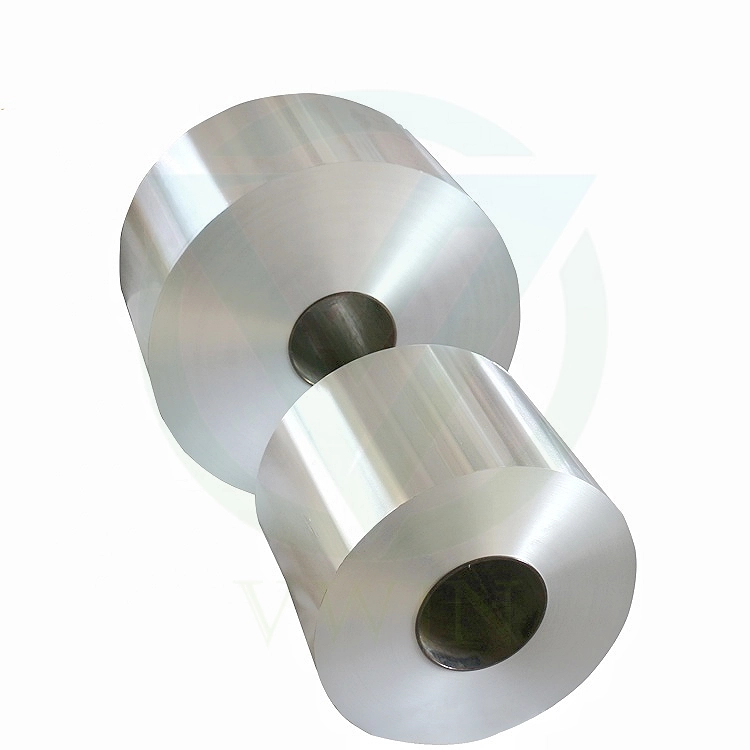
The base substrate is a biaxially oriented polyethylene terephthalate film, produced by extruding PET resin into a sheet and stretching it sequentially in the machine direction (MD) and transverse direction (TD). The orientation aligns the polymer chains, producing a film with tensile strength in the 180 to 230 MPa range, low elongation at break (60 to 120 percent), and excellent dimensional stability across temperature and humidity changes. The most common gauges for metallized PET film are 12, 15, 20, 25, 30, and 36 microns, with 12 micron being the workhorse for food packaging laminations.
The choice of PET as the base material is not accidental. PET has a glass transition temperature of approximately 78 degrees Celsius and a melting point of 260 degrees Celsius, which gives MPET excellent dimensional stability through solvent-based lamination drying tunnels (typically 60 to 80 degrees Celsius), hot-roll laminating stations (up to 120 degrees Celsius), and retort sterilization cycles up to 121 degrees Celsius. The film does not shrink, curl, or distort under typical converter processing conditions, which translates into higher machine throughput and lower rejection rates at the slitting and pouch-forming stages.
The aluminum layer is deposited by physical vapor deposition (PVD) in a vacuum chamber. A roll of PET film is unwound, passed over a chilled drum, and exposed to aluminum vapor produced by resistively heated boats or electron-beam guns. The aluminum condenses on the chilled film surface at a controlled deposition rate, building up a uniform layer 30 to 80 nanometers thick. The metallized film is then rewound and post-treated (typically corona treatment) to improve ink and adhesive wettability.
Key process parameters that determine MPET quality include vacuum level (typically 10 to the negative 3 to 10 to the negative 4 Pa), deposition rate, web speed, and aluminum purity (99.7 percent minimum for food contact). Variations in these parameters produce different optical densities, adhesion levels, and pinhole densities, which in turn determine the barrier performance of the finished MPET.
A typical 12 micron MPET consists of the PET base (11.5 to 11.8 micron) and the aluminum layer (30 to 80 nanometers), with the balance made up of any post-treatment coating. The yield, expressed as square meters of film per kilogram, is 60 to 62 m²/kg for 12 micron and 28 to 30 m²/kg for 25 micron. Yield is a key cost metric for converters, and it should be specified and validated against incoming roll weights. Variations in yield outside the 2 to 3 percent tolerance are typically a sign of inconsistent aluminum coating thickness.
The aluminum layer in MPET delivers an oxygen transmission rate (OTR) below 1 cc per square meter per day at 23 degrees Celsius and 50 percent relative humidity, and a water vapor transmission rate (WVTR) below 0.5 grams per square meter per day under the same conditions. These numbers place MPET firmly in the "high barrier" category required for products sensitive to oxidation: roasted coffee, milk powder, nuts, dried fruit, and processed meat. The barrier performance is one to two orders of magnitude better than plain BOPP or PET films, and within 10 to 20 percent of the performance of 7 micron aluminum foil laminations.
For B2B buyers comparing MPET against other substrates, the key specification to demand is the OTR measured at the laminate level rather than the film level, because lamination adhesives and secondary layers can shift final barrier performance by 20 to 40 percent. A reputable MPET supplier will share both substrate and laminate-level data, and will perform the testing in-house or in collaboration with a certified lab.
The metallized surface reflects more than 95 percent of visible light and almost all UV radiation in the 200 to 400 nanometer range. This is critical for products where light triggers flavor degradation: beer hops, vitamins, certain spice oils, and dairy-based infant formula. When combined with an outer print layer, MPET-based pouches can claim full light protection even with transparent windows on the front panel.
Optical density, measured with a transmission densitometer, is the standard spec for light barrier: OD of 2.0 to 2.5 is standard for general food packaging, while OD above 2.8 is used for light-sensitive pharmaceutical and dairy applications. Hangzhou VWIN's MPET is produced with controlled optical density across the full 2.0 to 2.8 range, with batch-level certification.
PET has a glass transition temperature of approximately 78 degrees Celsius and a melting point of 260 degrees Celsius, which gives MPET excellent dimensional stability through solvent-based lamination drying tunnels (typically 60 to 80 degrees Celsius), hot-roll laminating stations (up to 120 degrees Celsius), and retort sterilization cycles up to 121 degrees Celsius. The film does not shrink, curl, or distort under typical converter processing conditions, which translates into higher machine throughput and lower rejection rates at the slitting and pouch-forming stages.
The same heat resistance is also why MPET — and not MPE or MOPP — is used in retort pouches that must survive 121 degree Celsius sterilization. The four-product metallized film family (MPET, MPE, MCPP, MOPP) has different heat-resistance profiles, and MPET sits at the upper end for non-sealant applications.
The traditional foil-based structure — PET/AL/PE — delivers the highest possible barrier but uses a 7 to 9 micron aluminum foil that adds weight, increases cost, and complicates recycling. The MPET-based equivalent — PET/MPET/PE — achieves 85 to 90 percent of the barrier performance of foil at a 30 to 50 percent lower material cost, and it processes faster on high-speed form-fill-seal lines.
For most snack, confectionery, and dry-food applications, the move from foil to MPET is now standard practice. Foil-based structures are reserved for products with the most aggressive barrier requirements: pharmaceutical blister packs, retort pouches for long-shelf-life ready meals, and military or expedition rations. The economic driver of the foil-to-MPET switch is straightforward: a typical 12/12/70 PET/MPET/PE lamination is 25 to 40 percent cheaper per square meter than a 12/7/70 PET/AL/PE equivalent.
Standard MPET gauges for food packaging are 12, 15, 20, 25, 30, and 36 microns. The 12 micron grade is the workhorse for snacks and confectionery, where the film is laminated between a 12 micron PET print layer and a 50 to 80 micron PE sealant. Thicker MPET (25 to 36 micron) is used as a standalone barrier layer in stand-up pouches, pillow bags, and four-side-seal sachets where additional stiffness and puncture resistance are required.
Yield (m²/kg) is a key cost metric for converters. A 12 micron MPET typically delivers 60 to 62 m²/kg, while a 25 micron grade delivers 28 to 30 m²/kg. Suppliers should provide yield data in their datasheets, and buyers should validate it against incoming roll weights. Variations in yield outside the 2 to 3 percent tolerance are typically a sign of inconsistent aluminum coating thickness.
Hangzhou VWIN produces MPET in widths from 200 mm to 1,800 mm, with standard gauges of 12, 15, 20, 25, 30, and 36 microns. Optical density is calibrated to customer specification across the 2.0 to 2.8 range, with a standard target of 2.3 to 2.5 for general food packaging. Surface treatment options include single-side corona (42 dynes per cm minimum) and double-side corona for high-adhesion laminations.
Custom orders for non-standard widths, special optical densities, and pre-laminated MPET/PE or MPET/CPP structures are accepted with a minimum order quantity of 5,000 square meters for stock gauges and 10,000 square meters for custom gauges. Lead time for stock items is 7 to 10 days from purchase order; custom items typically ship within 21 to 30 days.
Hangzhou VWIN's MPET is produced under ISO 9001 quality management and follows 6S workplace standards. The production base is also certified to ISO 14001 for environmental management, and selected products carry GMI (Graphic Measurements International) and FSC (Forest Stewardship Council) certifications for sustainable sourcing.
For food contact, the aluminum layer and any post-treatment coatings are documented to comply with EU Regulation 1935/2004, US FDA 21 CFR (sections 174-177), and China GB 4806.7. Compliance documentation is provided with each shipment, including a Declaration of Compliance (DoC) and migration test reports for the specific lamination structure.
The most significant sustainability development in MPET-based packaging is the shift toward mono-material structures designed for mechanical recycling. Traditional PET/AL/PE laminates cannot be recycled through standard PET bottle streams because the aluminum layer and PE sealant contaminate the recyclate. New mono-material designs — such as BOPE/MPET/BOPE or PET/MPET/PET — allow the entire structure to enter the same recycling stream, with the aluminum layer recovered as a small but valuable fraction of the recyclate.
Major FMCG brands including Nestle, Unilever, and Mondelez have committed to 100 percent recyclable or reusable packaging by 2025 to 2030, and MPET plays a central role in delivering high-barrier recyclable structures. The barrier loss in moving from foil to MPET in mono-material structures is partially offset by the recyclability premium in markets with EPR (Extended Producer Responsibility) regulations.
PCR PET can be used as the base substrate for new MPET, though the optical clarity and barrier performance of PCR-derived MPET are typically 10 to 15 percent below virgin-grade material. For food-contact applications, PCR content is generally limited to 30 to 50 percent under EU and FDA guidance, with the rest coming from virgin PET. Hangzhou VWIN offers PCR-content MPET on request for customers with sustainability targets.
Independent life cycle assessment studies show that MPET-based laminates have a 30 to 45 percent lower carbon footprint than equivalent foil-based structures, primarily because of the energy savings from replacing 7 to 9 micron aluminum foil with 30 to 80 nanometer of vacuum-deposited aluminum. The thinner aluminum layer reduces both raw material extraction and the energy required for foil rolling. For converters with Scope 3 emissions reporting, the switch to MPET is one of the highest-leverage decarbonization moves available in flexible packaging.
Global demand for metallized films across all four product families (MPET, MPE, MCPP, MOPP) is forecast to grow at 5.5 to 6.5 percent CAGR through 2028, reaching approximately 2.8 million metric tons annually. MPET accounts for roughly 55 percent of total metallized film demand, with the largest growth segments in ready-to-eat meals, pet food, and pharmaceutical blister packaging. Capacity expansions in China, India, and Southeast Asia are outpacing demand growth, leading to stable prices and shorter lead times for B2B buyers.
Extended Producer Responsibility (EPR) regulations in the EU, Canada, and several US states are creating pricing signals that favor recyclable MPET-based structures over non-recyclable foil laminates. India's Plastic Waste Management Rules and China's dual-carbon policy are also pushing brand owners toward MPET-based designs. For B2B converters, the regulatory environment is a stronger demand driver than consumer preference alone.
The most visible technical trend is downgauging — replacing 12 micron MPET with 10 or 8 micron grades to reduce material consumption per package. Downgauging requires tighter aluminum coating uniformity and is enabled by improvements in vacuum metallization chamber design. A second trend is the use of high-barrier clear coatings (SiOx, AlOx) on MPET to push OTR below 0.1 cc/m²/day, matching foil performance for pharmaceutical and high-end food applications.
A premium European coffee brand switched from PET/AL/PE to PET/MPET/PE for its 250g whole-bean bag, achieving 12 months of shelf life at ambient storage. The MPET-based structure delivered 92 percent of the foil barrier at 38 percent lower material cost, allowing the brand to invest the savings in a resealable zipper and a one-way degassing valve.
A snack manufacturer in Southeast Asia replaced 15 micron MPET with 12 micron MPET in its potato chip bags, reducing material consumption by 18 percent with no measurable change in product shelf life or customer complaints. The move saved approximately USD 240,000 per year in film costs at 80 million bags of annual production.
A baby food brand needed a high-barrier pouch for milk powder that complied with EU 1935/2004 and FDA 21 CFR migration limits. Hangzhou VWIN's food-grade MPET, with documented migration test reports and a Declaration of Compliance, was selected and qualified in 8 weeks. The brand has since consolidated all of its Asian MPET sourcing to Hangzhou VWIN.
Symptom: The aluminum layer separates from the PET base during or after lamination. Cause: Insufficient surface treatment (corona) on the metallized side, or use of incompatible adhesive. Fix: Verify corona dyne level is 42+; switch to a two-component polyurethane adhesive; check lamination tension.
Symptom: The finished pouch shows OTR above 5 cc/m²/day despite using "high barrier" MPET. Cause: Pinholes in the aluminum coating from process upsets, or excessive adhesive penetration. Fix: Request optical density data and pinhole count from supplier; reduce lamination adhesive coat weight.
Symptom: The MPET roll shows a telescoping (conical) profile after slitting. Cause: Inconsistent winding tension, or excessive residual stress from the metallization process. Fix: Reduce rewind tension by 10 to 15 percent; condition the roll at 25 degrees Celsius for 24 hours before slitting.
Verify the supplier's annual production capacity (in million square meters) and current lead time for your gauge and width. A reliable supplier should have 20+ million square meters of annual capacity and lead times under 14 days for stock items.
Request the following documents before placing a trial order: ISO 9001 certificate, food contact compliance documents (EU/FDA/GB), optical density test reports, OTR/WVTR test reports, and a sample COA from a recent production batch.
For non-standard widths, optical densities, or pre-laminated structures, verify the supplier's R&D capability and minimum order quantity. A flexible supplier will accept custom orders at 5,000 to 10,000 square meters MOQ.
Hangzhou VWIN operates 40,000+ square meters of production space, with annual capacity exceeding 30 million meters. The company supports custom MPET gauges, widths, optical densities, and pre-laminated structures with 21 to 30 day lead times for custom orders. The company's Premium Food-Grade Extra Wide Extra Long Aluminum Foil Master Roll for Bakery Chain & Catering Wholesale demonstrates the same metallization technology used for MPET and serves as a benchmark for food-contact quality.
MPET is a polyester film with a vacuum-deposited aluminum layer 30 to 80 nanometers thick, while aluminum foil is solid metal typically 7 to 9 microns thick. MPET delivers 85 to 90 percent of foil's barrier performance at 40 to 60 percent of the cost, with better recyclability and faster converting.
For most snack applications (chips, nuts, confectionery), an OTR below 1 cc/m²/day at 23 degrees Celsius and 50 percent RH is sufficient. For oxygen-sensitive products such as roasted coffee or dried fruit, specify OTR below 0.5 cc/m²/day.
Yes, MPET from reputable suppliers is produced under food contact compliance with EU 1935/2004, FDA 21 CFR, and China GB 4806.7. Always request a Declaration of Compliance and migration test reports from the supplier.
Custom MPET (non-standard width, optical density, or pre-laminated structure) typically ships within 21 to 30 days from purchase order. Stock items usually ship within 7 to 10 days.
Yes, MPET is the standard barrier layer in retort pouches that undergo 121 degrees Celsius sterilization. The high heat resistance of PET (glass transition 78 degrees Celsius, melting 260 degrees Celsius) allows the film to maintain barrier performance through retort cycles.
MPET should be stored in a cool, dry environment (20 to 25 degrees Celsius, 50 percent RH maximum) in its original packaging. Avoid direct sunlight and high humidity, which can degrade the aluminum layer. Recommended shelf life is 12 months from date of manufacture.
MOQ for custom MPET is typically 5,000 square meters for stock gauges and 10,000 square meters for custom gauges. Some suppliers accept smaller trial orders for new customers.
For B2B buyers interested in MPET and related food-grade barrier materials from Hangzhou VWIN, the following products share the same metallization technology and quality system:
• Premium Food-Grade Extra Wide Extra Long Aluminum Foil Master Roll for Bakery Chain & Catering Wholesale — food-grade foil master roll produced in the same facility, ideal for bakery chain and catering applications
• Pre-cut Food-safe Embossed Square Shisha Foil for Professional Hookah — pre-cut foil sheets with food-safe embossing, suitable for hookah and food service
• Breathable Round Hookah Aluminum Foil Sheet in Blue Box — breathable foil sheets for hookah applications with retail-ready packaging
Metallized PET film is the workhorse barrier layer in modern flexible food packaging, delivering 85 to 90 percent of aluminum foil's barrier performance at 40 to 60 percent of the cost, with full recyclability when used in mono-material structures. For B2B converters, the key to sourcing high-quality MPET is verifying optical density, OTR/WVTR, and food-contact compliance documentation, and selecting a supplier with the production capacity and quality system to support consistent supply.
Hangzhou VWIN Technology produces MPET in widths up to 1,800 mm with annual capacity exceeding 30 million meters, supported by ISO 9001, ISO 14001, and full food-contact compliance documentation. The company supports both stock and custom MPET orders with 7 to 30 day lead times. Request a sample COA and trial order to qualify MPET for your specific application.


