
close
Choose Your Site
Global
Social Media


Views: 0 Author: Site Editor Publish Time: 2026-10-24 Origin: Site


Cold-chain logistics carry incredibly high stakes. A single temperature excursion compromises thousands of dollars in sensitive pharmaceuticals. Ruined perishable cargo devastates profit margins quickly. A torn pallet cover exposes critical shipments directly to ambient heat. Engineers face a specific material challenge here. Foil lamination delivers necessary radiant heat reflection. However, the base substrate dictates physical durability. It determines operational scalability and unit cost. Choosing between nonwoven and woven fabric alters performance completely.
This guide delivers a strict, evidence-based evaluation of both materials. We help procurement and packaging engineers align specifications precisely. You will learn how to match mechanical strength to your distinct transit profiles. Every transit lane features unique friction points. Pallets endure rough forklift loading daily. Understanding these materials prevents catastrophic thermal failures. Let us examine the exact structural differences.
Durability vs. Weight: Woven fabrics offer superior tensile and tear strength for aggressive handling and reusable loops, while nonwoven fabrics provide a lightweight, cost-effective solution for controlled, single-trip logistics.
Thermal Parity with Structural Differences: Both substrates achieve high radiant heat reflectivity (up to 95-97%) when properly laminated with aluminum foil, but their conductive heat transfer rates vary based on material thickness and density.
Cost-per-Use Economics: Nonwoven covers minimize upfront unit costs, whereas woven covers yield a lower long-term cost only if a reliable reverse logistics framework is in place.
Application Matching: The choice ultimately hinges on forklift handling realities, route duration, and compliance requirements rather than generic "insulation" claims.
You must define success criteria clearly before selecting a cold-chain cover. Effective covers delay dangerous temperature excursions. They survive severe transit friction without tearing. They also fit strictly within payload weight limits. Substrates play a foundational role in achieving these goals.
The outer foil layer handles the primary thermal work. It acts as a highly efficient radiant barrier. This metallic surface reflects ambient heat away from your payload. However, the substrate provides the mechanical skeleton. It dictates the structural integrity required to keep the foil intact during transit. A cracked or torn foil layer loses its reflective properties instantly. Ambient heat penetrates these gaps quickly.
Understanding field failure modes helps you prevent them. Warehouse environments are notoriously harsh. Equipment and handlers often damage packaging unintentionally.
Forklift punctures: Sharp tines easily pierce thin materials during hasty loading.
Tension tears: Automated stretch wrappers stretch covers beyond their tensile limits.
Friction abrasion: Dragging pallets across rough trailer floors wears through bottom edges.
Delamination: Poor bonding causes the foil to peel away from the substrate during humidity shifts.
Any physical breach compromises the entire thermal barrier. We see this often in fast-paced cross-docking environments. Therefore, matching your substrate to your handling reality is non-negotiable.
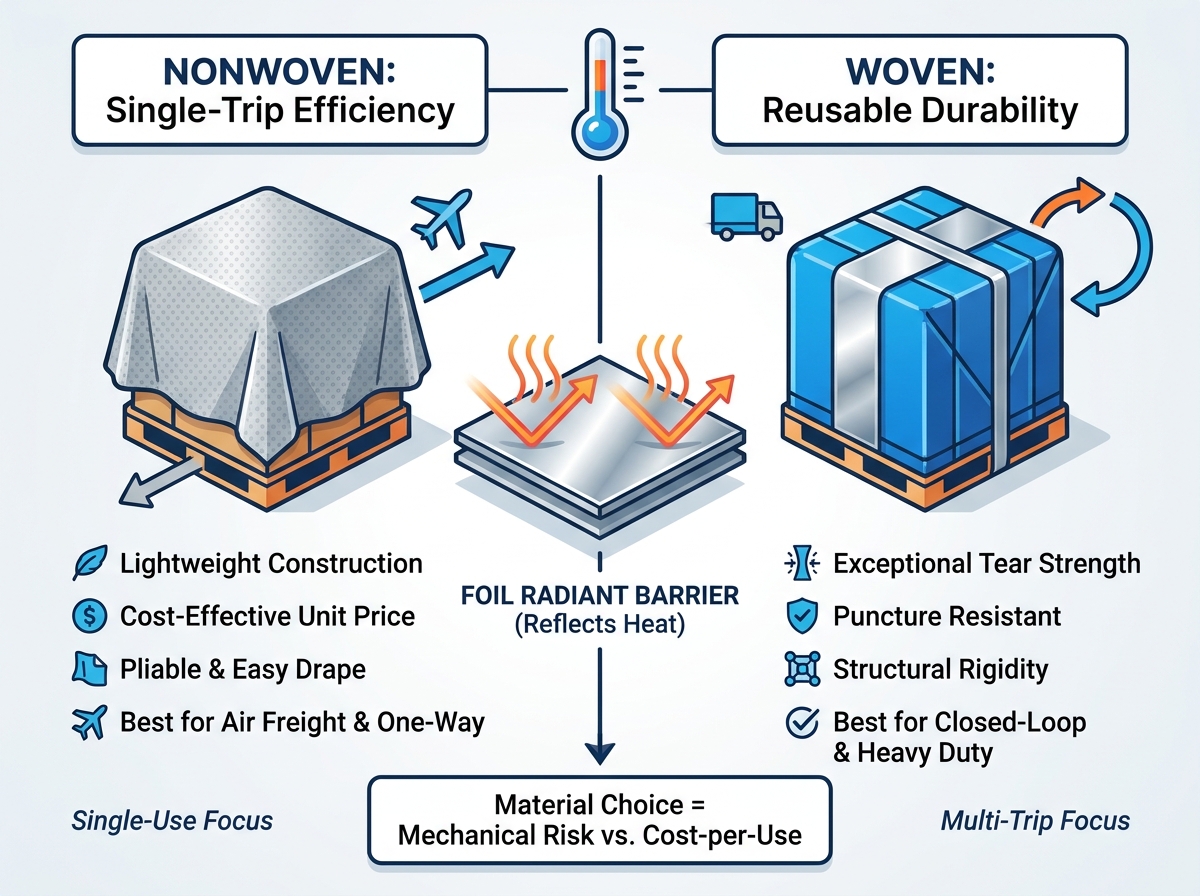
A standard aluminum foil nonwoven fabric relies on a specific manufacturing process. Producers typically use spunbond polypropylene. They bond this fibrous web directly to a foil or metallized film layer. This creates a flexible, cohesive material. It acts as effective metallized nonwoven insulation for standard temperature profiles.
This construction offers several primary advantages. Its lightweight nature dramatically reduces overall payload weight. This metric is critical for expensive air freight shipments. The material also features high pliability. You can easily drape it over irregular or asymmetrical pallet loads. Furthermore, it carries a significantly lower upfront unit cost. This makes it an ideal solution for strict single-use export scenarios.
However, implementation realities present clear risks. Nonwoven materials exhibit lower tensile resistance than woven alternatives. Their puncture resistance is also demonstrably weaker. A nonwoven foil pallet cover remains vulnerable to snagging. Rough wooden pallet splinters can easily rip the fabric. Aggressive warehouse handling will damage the thermal barrier quickly.
Best-Fit Scenarios:
High-volume, one-way international shipping routes.
Air freight logistics for fresh perishables and cut flowers.
Controlled pharmaceutical lanes featuring minimal physical touchpoints.
Environments where covers avoid severe mechanical stress entirely.
Common Mistake: Procurement teams often specify nonwoven covers for multi-stop domestic freight. The covers usually arrive shredded. Always reserve nonwoven options for gentle, direct-route logistics.
The structure of aluminum foil woven fabric differs drastically from nonwoven webs. Manufacturers create this substrate by weaving intersecting plastic tapes. These threads usually consist of tough polyethylene (PE) or polypropylene (PP). They then laminate heavy-duty aluminum foil onto this rugged grid. This produces formidable woven foil insulation for cold chain applications.
The primary advantages center on mechanical strength. Woven covers provide exceptional tensile strength. Their multidirectional tear resistance protects the payload relentlessly. If a puncture occurs, the woven grid stops the tear from spreading. This puncture resistance withstands aggressive forklift maneuvering easily. The material survives highly abrasive transit conditions. Its structural rigidity allows for repeated applications and removals.
Yet, heavy-duty construction introduces specific implementation risks. The heavier material weight limits its adoption in ultra-strict air freight. Higher initial procurement costs require careful justification. You must achieve a measurable return-on-investment through multiple trips. Additionally, the stiffer material proves marginally harder to fold. Warehouse workers may struggle to store them efficiently between uses.
Best-Fit Scenarios:
Closed-loop supply chains returning packaging to origin.
Reusable pharmaceutical transport lanes.
Heavy machinery and chemical cold transit requiring robust protection.
Less-than-Truckload (LTL) shipments heavily prone to cross-docking abuse.
Best Practice: Always establish clear sanitization protocols for reusable woven covers. Inspect the foil layers after every trip. Discard units showing significant foil delamination or tape fraying.
Selecting the right material requires comparing features to actual field outcomes. The choice between foil laminated nonwoven vs woven fabric demands a structured approach. We evaluate them across four primary lenses.
First, consider mechanical integrity. Compare tear strength directly. Woven fabric survives brutal cross-docking environments. It absorbs blunt force impacts effectively. Nonwoven fabric requires gentler handling. It serves perfectly well when loaded carefully into an air cargo hold.
Second, validate thermal efficiency carefully. We must address a persistent industry misconception. Many assume woven material is inherently "warmer" because it feels thicker. This is false. True conductive thermal resistance (R-value) depends on added bubble or foam inner layers. The core nonwoven vs woven insulated cover debate strictly focuses on the substrate. Both substrates achieve similar radiant reflectivity. The substrate merely maintains the barrier's physical integrity.
Third, analyze scalability and cost assumptions. Nonwoven materials offer predictable, linear cost scaling. They fit single-use consumable budgets perfectly. You buy them, use them, and discard them. Woven fabrics require capex-style budget forecasting. You must invest in tracking systems. Reverse logistics dictate their financial viability.
Finally, examine environmental and compliance factors. Recyclability poses massive challenges for both materials. Multi-material laminates resist standard recycling facility processes. They require specialized industrial separation. Woven fabrics add transit weight, slightly increasing fuel burn. Conversely, nonwoven reduces transit emissions through lighter payload footprints. However, reusable woven covers prevent landfill waste over time.
Evaluation Criteria | Aluminum Foil Nonwoven Fabric | Aluminum Foil Woven Fabric |
|---|---|---|
Substrate Structure | Spunbond Polypropylene (Fibrous) | Intersecting PE/PP Tapes (Grid) |
Tear & Puncture Resistance | Low to Moderate | Exceptionally High |
Radiant Heat Reflectivity | Up to 97% (Based on foil layer) | Up to 97% (Based on foil layer) |
Weight Profile | Lightweight (Ideal for Air Freight) | Heavier (Ideal for Ocean/Ground) |
Primary Cost Model | Low upfront unit cost (Consumable) | Higher initial cost (Reusable asset) |
Ideal Logistics Flow | Single-trip / Export-only | Closed-loop / Multi-trip returnable |
Do not finalize your specifications based on theoretical data alone. You must document your actual transit profile meticulously. Outline the lane durations clearly. Count the exact number of touchpoints. A touchpoint includes every time handlers load or unload the pallet. Identify the typical handling equipment deployed at each transfer station. Ground-level pallet jacks cause different damage than heavy reach trucks.
We strongly recommend conducting comprehensive ISTA testing. You must validate puncture resistance in action. Combine ISTA 7D temperature testing with ISTA 3A transit simulation. Thermal testing without physical mechanical stress provides useless data. You need to know if the cover performs after enduring vibration, shock, and drops.
Next, implement a strict pilot phase before full deployment. During this phase, you must monitor key performance indicators closely.
For nonwoven covers: Monitor exact tear rates upon arrival. If more than 10% of covers arrive breached, your lane is too rough.
For woven covers: Monitor return rates accurately. Track the labor costs associated with cleaning and sanitizing them for the next trip.
Use a clear decision framework to finalize your choice. If your return logistics capture rate falls below 40%, specify nonwoven. You will lose too much money replacing lost woven covers. Conversely, if handling involves more than four cross-docking events per trip, specify woven. Nonwoven covers will likely fail under that much mechanical stress.
Neither material proves universally superior in cold-chain logistics. The optimal choice requires a strict calculation balancing mechanical risk against unit cost. Your operational reality dictates the correct engineering path.
Procurement teams must stop evaluating these fabrics in isolation. You must match material tear-strength to the exact harshness of your transit lanes. Align your spending with your actual logistics capabilities. Choosing appropriately safeguards your payload, protects your budget, and ensures supply chain resilience.
Evaluate your handling environment before analyzing thermal claims.
Specify nonwoven materials strictly for lightweight, single-use logistics.
Leverage woven materials only when reverse logistics can guarantee asset returns.
Combine thermal testing with mechanical stress simulations to validate true performance.
A: No, the radiant reflection is similar. Both rely on the outer foil layer to reflect heat. Insulation value comes from trapped air or foam inner layers, while the base substrate strictly provides physical durability.
A: Yes, but it is highly susceptible to wear and tear after one or two trips. This fragility makes it an unreliable choice for closed-loop reusable programs requiring consistent thermal protection.
A: Woven fabrics typically command a 20-40% premium per unit due to manufacturing complexity. This higher upfront cost is justified only by multi-trip lifecycles or high-value cargo protection.
A: Generally no. The mixed-material lamination of plastics and metals makes them notoriously difficult to recycle. They require specialized industrial processing rather than standard municipal recycling streams.


