
close
Choose Your Site
Global
Social Media


Views: 0 Author: Site Editor Publish Time: 2026-10-18 Origin: Site


Selecting industrial-grade insulation or packaging materials presents a unique commercial challenge. You must balance high thermal reflectivity with robust mechanical durability to ensure project success. Pure radiant barriers easily tear during handling. Conversely, heavy-duty tarps offer brute strength but completely lack necessary thermal and vapor resistance. aluminum woven fabric directly bridges this performance gap. It combines a tough synthetic core with a highly reflective metallic surface.
This guide provides an evidence-based breakdown of the critical specifications. Buyers must evaluate these metrics closely. Proper selection prevents catastrophic material failure in the field. It also ensures strict building code compliance and optimizes overall project costs. We will dive into GSM, tear limits, and moisture barrier properties. You will learn how to specify exactly what your next commercial project demands.
GSM dictates application: Specifications ranging from 80 to 250+ GSM determine whether the fabric is suited for lightweight packaging or heavy-duty roofing insulation.
Woven scrim prevents catastrophic failure: High tear and tensile strength come directly from the internal PE/PP woven matrix, essential for mechanical fastening.
Foil vs. Metallized matters: True aluminum foil offers superior long-term thermal reflection and water vapor resistance compared to cheaper metallized film alternatives.
Supplier QA is non-negotiable: Partnering with a verified manufacturer ensures consistent lamination quality, preventing delamination under harsh environmental stress.
You need to understand the anatomy of the material before making procurement decisions. The structure relies on a precise composite layout. Manufacturers laminate outer layers of pure aluminum foil to a robust inner core. This core usually consists of high-density polyethylene (HDPE) or polypropylene (PP) woven fabric. The foil provides the reflective barrier. The woven core delivers structural integrity.
Using under-specced material creates severe business problems. It leads to vapor leaks and unwanted thermal bridging. It ultimately drives up replacement costs. Moisture trapped in wall cavities causes hidden damage over time. Conversely, over-speccing inflates procurement budgets unnecessarily. You do not need a maximum-weight fabric for basic temporary packaging. Aligning the physical material properties with your environmental risks requires checking specific aluminum foil woven fabric specifications.
You should establish baseline evaluation criteria to compare different products accurately. We categorize these into three main pillars. First, evaluate weight and thickness to determine handling constraints. Second, assess mechanical strength to ensure survival during installation. Third, review environmental resistance against moisture and chemicals. Balancing these three pillars guarantees optimal field performance.
Professionals use Grams per Square Meter (GSM) as the universal baseline. It measures the density and thickness of the material. GSM dictates how much raw material exists in a single square meter. A higher GSM typically means a thicker, stronger, and more resilient product. Understanding foil laminated woven fabric gsm helps you predict how the material will behave on a job site.
Industry standards divide woven aluminum insulation material into three specific GSM tiers. You must match the tier to your application.
Lightweight (60–90 GSM): This tier works best for export packaging and pallet covers. You can also use it for temporary radiant barriers. It performs well where high mechanical stress remains absent. One worker can easily carry these lightweight rolls.
Mid-weight (100–150 GSM): This serves as the industry standard. Contractors use it heavily for residential wall wraps. It also works perfectly for HVAC duct wrapping and standard roofing underlayments. It balances toughness with flexibility.
Heavy-duty (160–250+ GSM): You need this tier for exposed commercial roofing. It is required for heavy industrial lagging. It survives extreme weather barriers. These rolls are heavy and often require mechanical lifting on site.
You must weigh the cost-to-performance ratio carefully. Heavier GSM increases durability and handling ease during harsh weather. However, it significantly reduces roll yield. A heavier material means fewer square meters fit onto a standard roll. This inflates shipping costs and requires more storage space. You should not specify a 200 GSM fabric if a 120 GSM wrap meets local building codes.
Mechanical strength dictates material survival. Pure aluminum foil tears incredibly easily. If you crease pure foil, it weakens and cracks. The core value of this composite product is its rugged ability to withstand installation abuse. Workers will staple it, pull it aggressively, and step on it. High winds will try to lift it off roof decks. Checking the aluminum foil woven fabric tear strength ensures it survives this abuse.
Engineers evaluate tensile strength using two specific metrics. They test the Machine Direction (MD) and the Cross Direction (CD). MD refers to the strength along the length of the roll. CD refers to the strength across the width. High performance requires balanced strength across both axes. Wind loads hit building envelopes from unpredictable angles. If the CD strength is weak, the material will split vertically during a storm.
The woven grid architecture actively stops puncture propagation. Imagine a rogue nail penetrating the fabric during framing. The sharp point pierces the foil layer easily. However, the internal PE or PP woven scrim immediately catches the tear. It acts like a ripstop fabric. The tear cannot travel further than the next woven thread intersection. This localized damage is easy to patch later with foil tape.
You must match tear strength specifications to your preferred fastening method.
Mechanical Fastening: If you use staples or cap nails, mandate higher tear strength. The fasteners create concentrated stress points in the fabric.
Adhesive Bonding: If you use industrial spray adhesives, you can tolerate slightly lower tear strength. The adhesive distributes stress evenly across the entire surface.
Banding and Strapping: Industrial pipe lagging often requires metal bands. You need high puncture resistance to prevent the bands from cutting into the foil surface.
The physics of moisture barriers rely heavily on vapor permeance. Professionals measure this using Perm ratings. A lower Perm rating indicates better vapor blocking. True aluminum foil offers near-zero permeability. It acts as an absolute barrier. It stops moisture dead in its tracks. The water vapor resistance of foil woven fabric prevents costly structural degradation.
Preventing condensation remains critical for building envelopes and HVAC systems. When warm, humid air hits a cold surface, moisture condenses into liquid water. If this happens inside a wall cavity, mold grows rapidly. Wood framing rots. By installing a high-quality foil woven barrier, you keep the moisture out of the cavity. It stops interstitial condensation entirely. HVAC ducts wrapped in this material will not sweat during humid summer months.
You must also address chemical and corrosion resistance. Aluminum is highly reactive when exposed to specific elements. It degrades quickly in highly acidic or highly alkaline environments. For example, wet concrete has a very high pH. If you install bare aluminum foil directly against wet concrete, the alkali will eat through the foil. In these aggressive environments, you must specify materials with anti-glare or anti-corrosion polymer coatings. These protective topcoats shield the fragile aluminum layer from chemical attack.
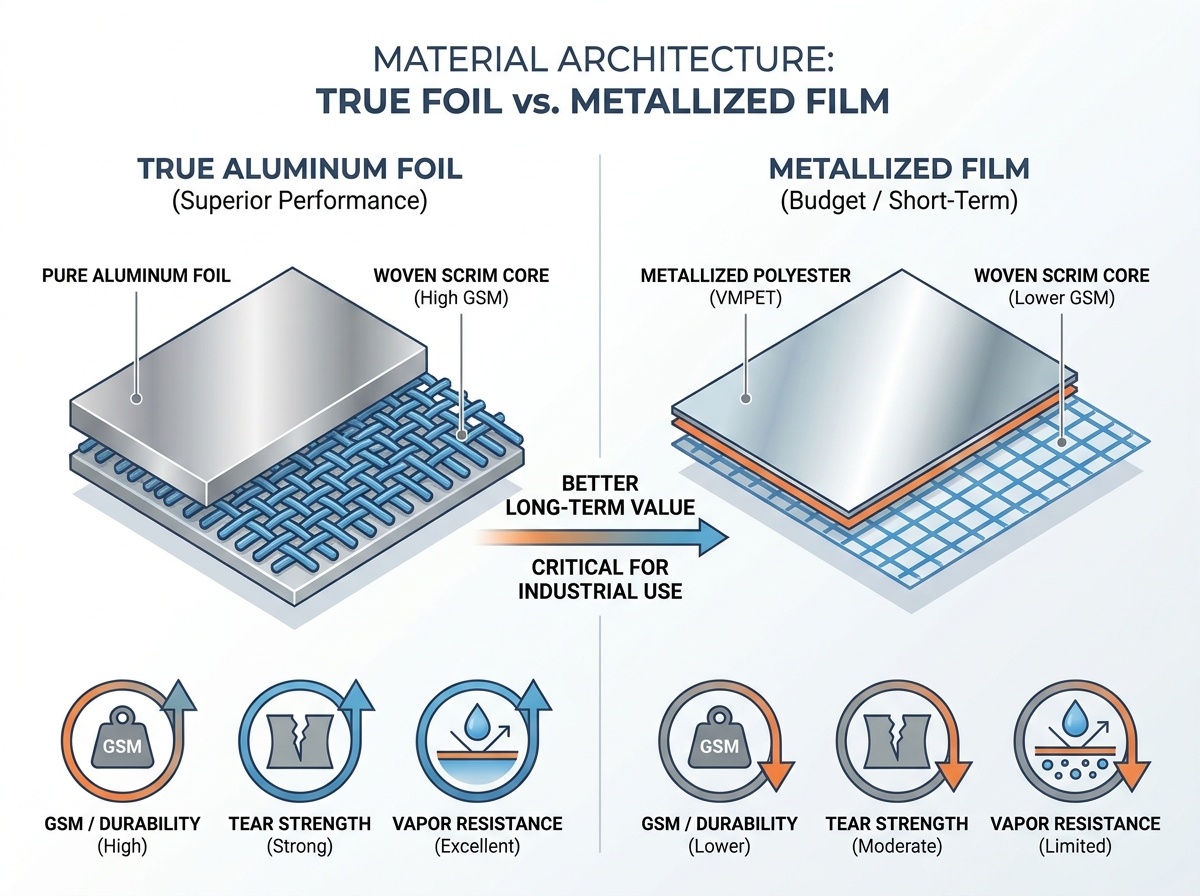
Procurement teams often confuse true foil laminated woven fabrics with metallized polyester alternatives. Metallized films, commonly known as VMPET, look very similar. They have a shiny, silver surface. However, their physical properties differ drastically. VMPET features a microscopically thin layer of vaporized aluminum deposited onto a plastic film. True foil uses a solid sheet of actual aluminum metal. You must understand these differences before buying.
We can break down the performance differences into three key areas. True foil reflects up to 97% of radiant heat over the long term. Metallized films degrade much faster. Their reflectivity drops as the thin metal layer oxidizes. Furthermore, true foil generally achieves better ASTM Class A fire ratings. It does not burn easily. VMPET contains more plastic, which melts and drips under extreme heat. Finally, true foil provides an absolute moisture barrier. Metallized film can flex, crack, and become porous over time.
Use clear decision logic when specifying materials. You should specify metallized film for budget-sensitive applications. It works well for short-term transit packaging or internal bubble mailers. You must mandate true foil for permanent residential construction. It is also non-negotiable for harsh industrial insulation projects where long-term survival is required.
Material Performance Comparison
Performance Metric | True Aluminum Foil Composite | Metallized Film (VMPET) Composite |
|---|---|---|
Thermal Emissivity | Maintains 97% reflection for decades. | Degrades rapidly under UV and oxidation. |
Vapor Permeability | Near-zero (Absolute Barrier). | Can become porous with repeated flexing. |
Fire Safety Rating | Frequently achieves ASTM Class A. | Prone to melting; lower fire resistance. |
Cost Profile | Higher initial procurement cost. | Highly budget-friendly. |
Evaluating supplier capabilities goes far beyond simply reading a spec sheet. You are relying on their quality control processes. If their manufacturing environment fluctuates, your material will fail. Finding a reliable aluminum foil woven fabric manufacturer minimizes these inherent risks. You should interrogate their production methods directly.
Lamination integrity determines the lifespan of the material. Delamination is a major risk. When a roof reaches extreme temperatures in the summer, poor lamination fails. The foil peels away from the woven core. Ask manufacturers about their specific bonding processes. Extrusion coating typically offers a stronger, more permanent bond than simple adhesive lamination. You should demand peeling strength guarantees in writing before placing a bulk order.
Certifications and compliance prove product validity. Ensure the supplier provides independent testing data. They should not rely on internal, unverified lab results. Request their ASTM E84 test reports for fire retardancy. Ask for their ASTM E96 results regarding vapor transmission rates. Verified tensile strength data ensures the material matches local building code requirements.
Finally, assess their customization capacity. Different climates require different configurations. You might need single-sided foil for standard roofing. You might require double-sided foil to block heat in two directions. Sometimes, you need perforated variants. Perforated fabrics allow moisture vapor to escape while still blocking liquid water and radiant heat. A strong manufacturer can adjust their lines to meet these specific project needs without demanding excessive lead times.
Selecting the right specifications is an exercise in matching environmental risk with material durability. You cannot rely on guesswork when dealing with building envelopes or sensitive industrial packaging. Understanding the role of GSM helps you balance handling weight against long-term resilience. Mastering tear strength metrics ensures your materials survive the brutal realities of mechanical fastening and high wind loads.
Take proactive next steps before committing to any bulk procurement. We recommend conducting a pilot test with physical material samples on your actual job site. Review all third-party laboratory reports carefully to verify fire and vapor ratings. Ensure you align the material’s GSM and tear strength requirements strictly with your specific installation environment. By doing so, you guarantee superior performance and eliminate the costly risk of early material failure.
A: It typically ranges from 110 to 130 GSM for standard residential construction and wall wraps. For exposed environments or industrial grades, specifications can push up to 250 GSM to withstand extreme mechanical stress.
A: It shares similar tensile strength because both rely on an internal PE or PP woven core. However, the aluminum composite adds rigidity and provides absolute UV and radiant heat barrier properties that standard tarps completely lack.
A: Yes. True foil composites act as highly effective Class 1 vapor retarders. They easily block ground moisture when installed in crawl spaces, provided all overlapping seams are properly sealed with industrial foil tape.
A: Surface scratches marginally reduce local thermal reflectivity and can compromise absolute vapor barrier integrity. This highlights why specifying higher GSM woven cores is crucial; the thicker core prevents full punctures during rough handling.


