
close
Choose Your Site
Global
Social Media


Views: 0 Author: Site Editor Publish Time: 2026-10-11 Origin: Site


Standard insulation tapes frequently fail when industrial environments reach extreme heat levels. Continuous thermal stress silently destroys weak adhesives and unreinforced backing materials in a matter of weeks. These rapid degradations lead to severe energy loss, compromised HVAC system integrity, and dangerous safety hazards for facility workers. Without adequate structural reinforcement, continuous heat simply melts away traditional sealing solutions.
Enter fiberglass mesh aluminum foil tape, a highly engineered solution designed specifically for environments demanding high tensile strength and robust thermal reflectivity. This comprehensive guide provides procurement teams, facility managers, and contractors with a clear, evidence-based framework for choosing the correct tape specification. You will learn exactly how to align continuous temperature thresholds, specific adhesive chemistry, and vital regulatory compliance requirements to your daily industrial applications.
Structural Integrity: The fiberglass mesh backing prevents the tearing and elongation common in unreinforced foil tapes under thermal expansion.
Adhesive Chemistry Matters: Selection must align with operating temperatures; acrylics handle moderate heat, while silicone-based adhesives are required for extreme environments.
Safety & Compliance: Proper installation requires adherence to handling guidelines to mitigate respiratory and dermal risks associated with fiberglass particulates.
Application Specificity: Procurement should match tape specifications (e.g., thickness, width, adhesive type) directly to the application, whether for HVAC, industrial pipe insulation, or aerospace.
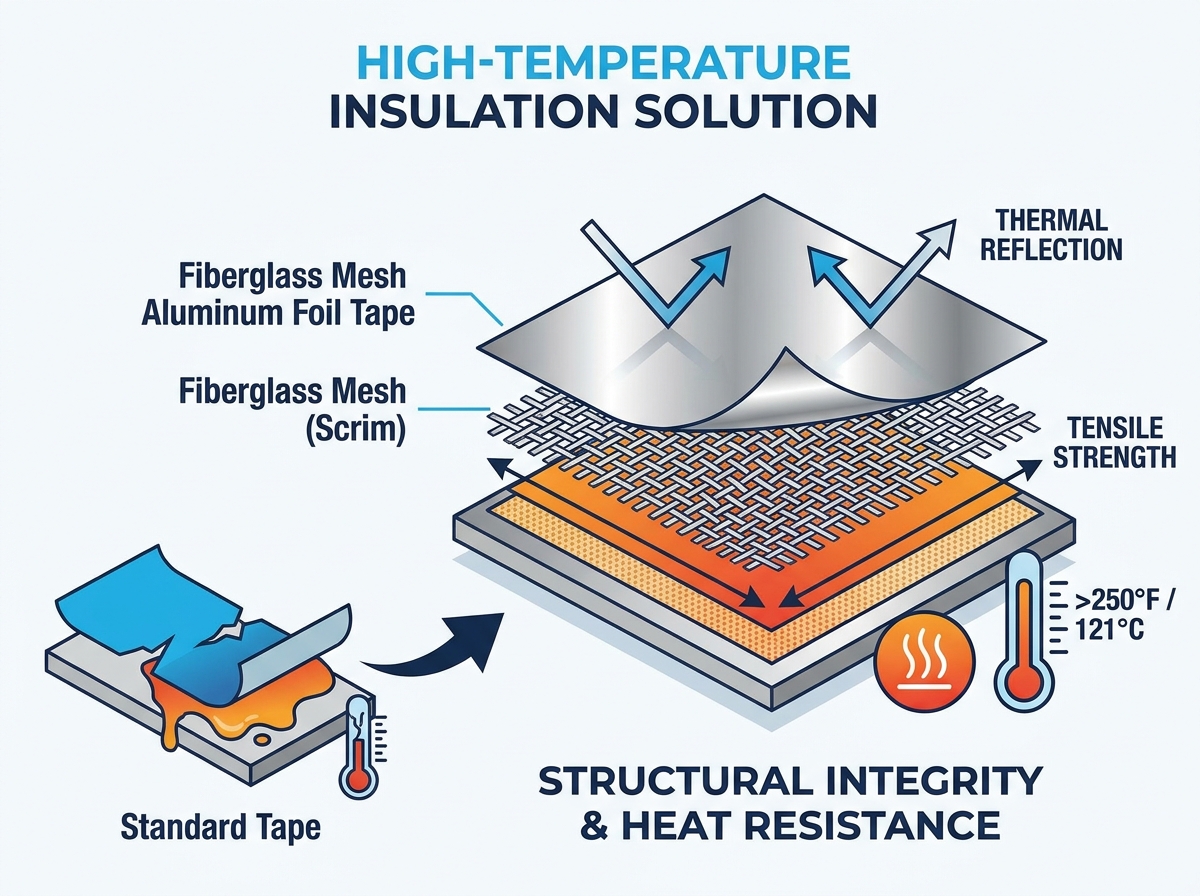
Unreinforced metal tapes suffer from predictable failure modes when exposed to continuous heat. Standard foil completely lacks internal structural scaffolding. When thermal expansion forces surrounding materials to shift, standard tapes cannot absorb the mechanical stress. Above 150°F, unreinforced metal expands rapidly. This movement shears the underlying adhesive layer. Delamination inevitably starts at the exposed edges. The tape eventually dries out, turns brittle, and falls away from the substrate.
Adding a fiberglass scrim completely changes the mechanical physics of the tape. The cross-woven glass matrix acts as a durable internal skeleton. It distributes mechanical stress evenly across the entire surface area. When system joints expand and contract, the fiberglass web absorbs the tension. This prevents micro-tears from propagating across the fragile metal surface. Structural integrity remains intact even during violent thermal cycling.
Higher initial material costs for heat resistant aluminum foil tape yield vast operational returns. Investing in reinforced solutions drastically reduces maintenance downtime. You avoid catastrophic insulation failures requiring expensive emergency repairs. Industrial facilities maintain consistent thermal barriers over many years. Energy efficiency stays perfectly stable, safeguarding system performance and operational budgets.
High-performance tapes rely on three distinct layers working in unison. The outer layer consists of pure aluminum foil. Manufacturers typically roll this foil to thicknesses between 1 and 5 mils. Thicker foils provide superior puncture resistance. They reflect radiant heat aggressively away from sensitive components. The continuous metal surface also serves as an absolute vapor and moisture barrier. It stops condensation from penetrating the underlying insulation.
The middle layer forms the structural core. Manufacturers weave inorganic glass fibers into a tightly bonded scrim. These glass fibers possess unique chemical properties. They remain completely impervious to extreme heat. Fiberglass cannot burn, making it inherently fire-retardant. The mesh locks the fragile foil layer into a rigid dimension. This prevents elongation during heavy-duty wrapping tasks.
The final layer dictates the actual thermal limits of any aluminum foil fiberglass tape. Adhesive selection remains the most critical procurement decision. You must match the foil fiberglass cloth tape adhesive directly to your operating environment.
High-Performance Acrylic: Engineered for exceptional initial tack and long-term aging resistance. Acrylic adhesives resist UV oxidation and moisture breakdown. They perform flawlessly in moderate high-temperature environments. Maximum continuous exposure typically tops out around 250°F (121°C).
Silicone Adhesives: Absolutely required for extreme thermal environments. Silicone chemistry handles continuous exposure up to 500°F (260°C). They demand strict surface preparation for successful bonding. Silicone adhesives also require specific curing times to achieve maximum hold.
Beyond standard silver configurations, specialty variations dominate niche industries. Aerospace and automotive sectors frequently utilize gold fiberglass cloth aluminum foil tape. The gold tinting maximizes radiant heat reflection in tight engine bays. These specialty variations secure wiring harnesses and reflect aggressive engine heat away from critical sensors.
Adhesive Type | Max Continuous Temp | Initial Tack | Best Application Scenarios |
|---|---|---|---|
Standard Rubber | 140°F (60°C) | Very High | Temporary sealing, non-thermal environments |
High-Performance Acrylic | 250°F (121°C) | Moderate to High | HVAC ducts, standard pipe insulation, outdoor exposure |
Industrial Silicone | 500°F+ (260°C+) | Low (requires pressure/cure) | Exhaust systems, aerospace, heavy industrial boilers |
Procurement teams must carefully decipher manufacturer specification sheets. Understanding the precise difference between operating limits and peak limits prevents disastrous failures. Continuous operating temperature dictates what the tape withstands 24/7 without degrading. Peak exposure limits only apply to short-term spikes lasting minutes or hours. Never specify a tape based solely on its peak temperature rating.
Mechanical durability metrics matter just as much as thermal limits. Tensile strength measures the pulling force required to break the material. High tensile strength proves essential when wrapping irregular geometries or sharp metal brackets. Puncture resistance ensures rogue screws or tools will not compromise the vapor barrier. You need robust metrics in both categories to guarantee long-term system integrity.
Adhesion strength directly determines field reliability. Manufacturers benchmark this using "Adhesion to Steel," measured in ounces per inch (oz/in). While this provides a useful baseline, field realities often differ. You must test the fiberglass mesh foil tape for high temperature insulation directly on your specific substrates. Dusty fiberglass batts and oily metal pipes dramatically alter real-world bonding strengths.
Regulatory compliance remains strictly non-negotiable for commercial buildings. Inspectors look for specific fire safety certifications. UL 723 and ASTM E84 represent the gold standards in North America. These tests measure the surface burning characteristics of building materials. They generate specific indices for flame spread and smoke development. A Class A fire rating ensures the tape will not actively fuel a building fire.
Evaluation Metric | Industry Standard Target | Why It Matters in the Field |
|---|---|---|
Tensile Strength | > 25 lbs/inch width | Prevents snapping when pulled tightly around pipe elbows. |
Adhesion to Steel | > 45 oz/inch width | Ensures the edge will not lift or flag over time. |
Moisture Vapor Transmission | < 0.05 perms | Stops condensation and prevents under-insulation corrosion. |
Flame Spread Index | < 25 (Class A Rating) | Guarantees compliance with commercial building fire codes. |
Engineered sealing solutions serve a massive variety of industrial applications. Facility managers rely on these reinforced barriers anywhere extreme heat intersects with vital infrastructure. Applying the correct specification guarantees the underlying system operates safely and efficiently.
Industrial Pipe & Boiler Insulation: Securing heavy-duty insulation batts requires immense strength. High temperature foil tape for pipe insulation seamlessly bridges the seams of metallic vapor barriers. It actively protects complex boiler networks against moisture ingress and devastating localized condensation.
HVAC Systems: Commercial air distribution systems endure constant pressure fluctuations. Facility teams use reinforced tape to seal rigid fiberglass ductwork and flexible air joints. The mesh handles continuous vibration while the foil locks conditioned air securely inside the system.
Marine & Aerospace Manufacturing: Weight-to-strength ratios dictate engineering decisions in transit sectors. Aircraft and marine vessels require verifiable fire retardation. Reinforced tapes secure wiring harnesses and vital fluid lines near hot turbine exhaust zones without adding excessive weight.
Automotive Exhaust & Heat Shields: Localized heat containment prevents sensitive electronics from melting. Heavy-duty silicone variants secure thermal wraps around exhaust manifolds. They reflect intense radiant energy away from the passenger cabin and delicate engine sensors.
Handling industrial glass fibers requires strict adherence to safety protocols. We must address these valid concerns objectively. The physical mechanism of fiberglass exposure involves microscopic glass shards. When manipulated roughly, these tiny fragments break off and become airborne. They cause immediate micro-abrasions on unprotected skin. Inhaling these particulates severely irritates the upper respiratory tract.
Installation best practices mitigate these risks entirely. Personal Protective Equipment (PPE) remains mandatory on professional jobsites. Installers must wear heavy-duty nitrile gloves to prevent dermal abrasions. Long sleeves stop rogue fibers from sticking to sweaty arms. Properly fitted N95 respirator masks block dangerous airborne particulates during intensive cutting and shaping procedures.
Surface preparation dictates the ultimate success of your installation. Even the most aggressive acrylic adhesive fails on a dirty substrate. You must meticulously clean all application surfaces. Wipe down pipes and ducts using industrial solvents. Remove all grease, machine oil, loose dust, and lingering moisture. Allow the surface to dry completely before applying any tape.
Application technique separates amateur installations from professional results. Never simply press the tape down with a bare hand. Use a hard plastic squeegee to apply firm, even pressure along the entire seam. This mechanical force eliminates trapped air pockets. It ensures maximum adhesive wet-out, pressing the chemical bonding agents deep into the microscopic pores of the substrate.
Selecting the optimal sealing solution requires a systematic approach. Define your thermal baseline before examining any product catalogs. Identify the maximum continuous operating temperature your system genuinely faces on a daily basis. Do not rely on loose estimates; use calibrated thermal imaging if necessary.
Assess mechanical stress aggressively. Determine if the wrapped insulation faces constant machine vibration, rapid thermal expansion, or physical abrasion from nearby foot traffic. High-stress environments demand denser fiberglass mesh counts and thicker aluminum layers to survive the abuse.
Finally, demand concrete proof before committing your budget. Request formal Technical Data Sheets (TDS) and physical product samples directly from manufacturers. Test various tape configurations in your specific operational environment. Observing real-world adhesion on your actual substrates ensures you secure the perfect thermal barrier for your facility.
A: The maximum continuous operating temperature depends entirely on the adhesive system. High-performance acrylic adhesives typically withstand continuous heat up to 250°F (121°C). Industrial-grade silicone adhesives handle extreme continuous exposures between 500°F and 600°F (260°C to 315°C). Always verify the manufacturer's Technical Data Sheet (TDS) rather than relying on generic marketing claims.
A: Standard duct tape uses a polyethylene-coated cloth backing and rubber-based adhesives. These rubber adhesives dry out, turn brittle, and fail rapidly above 140°F. Conversely, specialized foil tapes use an inorganic fire-retardant glass fiber matrix. They employ engineered acrylic or silicone adhesives designed specifically to resist thermal degradation and oxidation over years of exposure.
A: The continuous aluminum foil face acts as an impermeable vapor and moisture barrier. However, the overall installation is only waterproof if you seal every edge and seam perfectly. Moisture can still ingress under the adhesive layer if the initial application surface was dirty or if air pockets were left behind during installation.
A: Yes, but only if the existing insulation jacket remains completely clean, dry, and structurally sound. Adhesives cannot bond to dusty, oily, or crumbling surfaces. You must wipe down the existing substrate with an appropriate solvent and let it dry completely before application to ensure the adhesive wets out properly.


