
close
Choose Your Site
Global
Social Media


Views: 0 Author: Site Editor Publish Time: 2026-06-27 Origin: Site


In global logistics, temperature excursions and moisture ingress at tarmac transfer points represent primary drivers of cargo loss. Standard thermal blankets frequently fail under heavy stress due to poor puncture resistance or rapid material degradation. When cargo waits on sunny loading docks, it demands robust, fail-safe protection. Transitioning to Aluminum Foil PET Laminates offers a scientifically sound solution for safeguarding high-value freight. These composites brilliantly combine the absolute isolation properties of pure foil and the rugged structural integrity of polyester (PET). This engineered synergy prevents environmental threats from penetrating the pallet enclosure.
This guide breaks down the underlying structural mechanics and performance benefits for procurement teams evaluating pallet cover materials. You will learn exactly how these multi-layer laminates operate in harsh environments. We will also explore the durability advantages and provide an evaluation framework to help you shortlist the right material suppliers effectively.
Cargo sitting on airport tarmacs or loading docks faces a brutal combination of extreme radiant heat, sudden precipitation, and physical abrasion. Standard stretch films offer virtually zero thermal mass. Single-layer reflective bubble wraps provide marginal insulation but suffer from severely low puncture resistance. A forklift operator slightly grazing a standard thermal blanket often tears it open. Once a tear occurs, the protective environment collapses immediately. Ambient humidity and heat rush in, compromising the payload. Supply chains require materials engineered for abuse, not just static storage.
Pure aluminum foil provides an exceptional protective layer. It stops gases and moisture entirely. However, raw foil suffers heavily from "flex-fatigue." When you fold, rub, or shake pure aluminum during transit, it develops micro-pinholes. Industry professionals measure this degradation using Gelbo flex testing. Under dynamic movement, raw foil deteriorates quickly. A protective wrap riddled with microscopic holes ceases to function as a hermetic seal. Therefore, relying on unreinforced foil for heavy pallet covers inevitably leads to cargo damage during turbulent transit conditions.
Engineers solve this fragility by fusing aluminum foil together with PET (polyethylene terephthalate). This lamination process creates a durable composite. It survives aggressive handling while maintaining absolute atmospheric isolation. The outer polymer layers absorb the physical shock. The inner metallic core remains intact and functional. You get the ruggedness of industrial plastics combined directly into the unyielding isolation of metal. This material synergy forms the foundation of modern, high-performance pallet protection.
To understand why this composite excels, we must deconstruct its layered architecture. Each tier performs a specific, highly engineered logistic function. Manufacturers permanently bond these layers using advanced adhesives or extrusion processes. They operate as a single, cohesive shield.
The exterior layer consists of oriented polyester (PET). It acts as the primary structural shield for the entire cover. PET delivers extremely high tensile strength and tear resistance. It also offers excellent UV stability. Sunlight will not degrade the plastic over long tarmac delays. Crucially, this robust outer shell prevents the underlying foil from scratching or tearing during forklift operations. We rely on this layer to take the physical beating so the delicate metal core remains pristine.
Positioned safely in the middle, the aluminum foil serves as the ultimate zero-permeability barrier. Unlike plastics, metal physically blocks molecules. It reflects up to 97% of radiant heat away from the pallet. It completely blocks light, moisture, and gas exchange. This metallic core keeps the internal pallet environment entirely isolated from the outside world. Typical heavy-duty applications utilize foil thicknesses ranging from 6 to 20 microns to guarantee zero atmospheric transmission.
The innermost layer typically features polyethylene (PE). PE acts as the vital sealing agent. Pure aluminum cannot be heat-sealed to itself easily. PE melts at roughly 110°C, allowing manufacturers to securely heat-seal the material panels together. Stitched seams create needle holes, ruining the isolation. Integrated heat sealing ensures no thermal or moisture leaks occur at the seams of the pallet cover. The continuous melted bond creates a truly hermetic enclosure.
| Composite Layer | Material Material | Primary Logistic Function |
|---|---|---|
| Exterior | PET (Polyethylene Terephthalate) | Provides high tensile strength, UV stability, and puncture resistance against handling abuse. |
| Core | Aluminum Foil (6-20 Microns) | Delivers absolute zero-permeability against gases, moisture, and reflects 97% of radiant heat. |
| Interior | PE (Polyethylene) | Enables secure heat-sealing, creating airtight seams without compromising the foil core. |
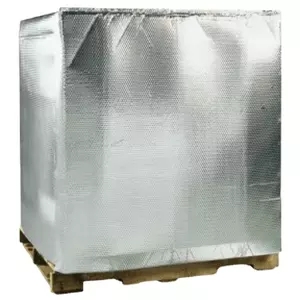
When transporting temperature-sensitive payloads, relying on high-performance laminates mitigates major operational risks. A broken link in the cold chain normally leads to immediate product spoilage. Laminated pallet covers provide passive thermal defense during these exact vulnerable moments.
Direct sunlight wreaks havoc on tarmac cargo. It causes rapid, localized temperature spikes. Radiant heat deflection remains crucial for pharmaceuticals, perishables, and sensitive electronics. The aluminum layer bounces solar radiation actively away from the pallet. Instead of absorbing the heat like standard opaque plastics, the shiny metallic core acts as a mirror. This reflection significantly delays internal temperature spikes, giving ground crews vital extra hours to load the freight into refrigerated facilities.
Global shipping routes expose cargo to wild environmental swings. A pallet might leave a frozen facility and land in a desert port. Laminated covers maintain their physical stability and structural integrity across harsh environments. They perform reliably in ambient temperatures ranging from -40°C all the way up to 120°C. The PET does not shatter in freezing conditions, and the PE sealing layer does not delaminate under intense port heat.
Humidity poses an insidious threat to cargo. Moving from a cold airplane hold to a humid loading dock generates rapid condensation. The near-zero WVTR (Water Vapor Transmission Rate) of the foil core prevents ambient humidity from penetrating the cover. It keeps the internal air volume completely dry. This control mitigates the risk of mold growth and rust formation. It also prevents corrugated cardboard packaging inside the pallet from turning soggy and collapsing under its own weight.
Busy shipping ports contain heavy atmospheric pollutants. Diesel exhaust fumes, chemical vapors, and saline sea breezes constantly bombard waiting cargo. Standard plastics often absorb these odors, passing them into the payload. Aluminum foil offers supreme chemical resistance. It protects sensitive cargo from external vapors and exhaust fumes. Your high-value pharmaceutical or food ingredients arrive untainted by the industrial environments they passed through.
Procurement teams frequently focus only on the initial acquisition price of shipping consumables. This mindset ignores the massive savings generated by durable, multi-trip packaging solutions. Laminated covers shift the financial equation entirely.
The PET lamination drastically improves the material's score in standard physical testing. When evaluated using the ASTM F1306 puncture test, the composite requires significantly more force to penetrate than raw foil or bubble wrap. During Gelbo flex testing, the laminate withstands thousands of twists without developing pinholes. Because it resists both impacts and folding fatigue, the cover survives the brutal realities of logistics hubs. Operators can drag, stack, and strap the pallets without destroying the barrier.
Because the laminate resists tearing and deformation, procurement teams can shift their operational models. You no longer need to discard pallet wraps after a single journey. You can implement a reusable pallet cover program. Ground teams easily fold and return the covers for the next outbound shipment. This operational shift transforms a disposable packaging expense into a manageable, long-term logistical asset.
The initial acquisition cost of engineered composites is undeniably higher than standard metalized stretch films. However, you must calculate the cost per trip. An inexpensive wrap thrown away after one flight offers terrible long-term value. An engineered laminate cover completing ten transit loops dramatically undercuts the disposable alternative. The extended lifecycle yields a net-positive return on investment within just 3 to 5 shipments. Every trip after that represents pure packaging cost savings.
| Metric | Standard Single-Use Wrap | Reusable Laminate Cover |
|---|---|---|
| Puncture Resistance | Low (Prone to forklift tearing) | High (Protected by PET shield) |
| Gas/Moisture Barrier | Moderate to Poor | Absolute (Near-Zero OTR/WVTR) |
| Typical Lifespan | 1 Transit Loop | 10+ Transit Loops |
Not all laminated materials offer the same real-world performance. Many suppliers sell basic metalized plastics disguised as true foil composites. Procurement managers must rigorously evaluate potential vendors to ensure cargo safety.
Aluminum Foil PET Laminates represent a highly engineered, defensible choice for protecting high-value or temperature-sensitive freight. They permanently solve the inherent fragility of pure foil while vastly outperforming standard commercial plastics in barrier protection. By deflecting radiant heat and sealing out moisture, they secure the integrity of your most sensitive payloads during unpredictable logistics delays.
To implement this solution effectively, procurement and supply chain leaders should take immediate action:
A: Metalized PET has a microscopic layer of vaporized aluminum. It is lightweight and flexible but does not offer the absolute, zero-permeability gas and moisture barrier of true Aluminum Foil PET Laminates.
A: Because they are multi-material composites, they cannot easily enter single-stream recycling. However, their primary environmental benefit lies in their heavy-duty, reusable nature, which drastically reduces single-use plastic waste over time.
A: No. They are passive thermal protections designed to maintain existing temperatures and delay excursions during broken links in the cold chain (like loading docks), rather than actively cooling the cargo.


