
close
Choose Your Site
Global
Social Media


Views: 0 Author: Site Editor Publish Time: 2026-10-30 Origin: Site


Selecting the right barrier film for dry foods often feels like walking a tightrope. You need reliable protection against oxidation, moisture ingress, and UV degradation. However, you must avoid over-engineering your packaging costs. The stakes are incredibly high in modern food manufacturing. Poor choices lead to premature spoilage. Powders suffer from severe clumping. Consumers experience noticeable flavor loss. Conversely, using unnecessarily thick laminates quickly erodes your profit margins.
This article solves this exact engineering and procurement challenge. We will explore a clear technical framework for your packaging strategy. You will understand how to balance absolute protection against commercial reality. By comparing metallized structures against traditional foil, you will learn exactly which option suits your specific product. We will guide you through matching material performance to your scalable food packaging lines.
Absolute vs. Functional Barriers: Aluminum foil (PET/AL/PE) provides a near-absolute barrier (OTR/WVTR approaching 0), while metallized films offer a functional, highly efficient barrier suitable for mid-to-long shelf-life goods.
Cost and Yield Efficiency: Metallized films significantly reduce material weight and cost per square meter compared to foil laminates.
Machinability and Durability: Foil is susceptible to flex-cracking and pinholing during transit, whereas metallized films offer better flexural flexibility but lower puncture resistance.
Application Logic: Choose PET/AL/PE for ultra-sensitive products (e.g., milk powders, premium coffee); choose metallized films for high-turnover dry snacks, baked goods, and standard dehydrated foods.
Dry foods face constant environmental threats during distribution. Moisture is the most immediate danger. Water vapor enters the package and alters the product texture. Powders suffer from severe clumping. Baked snacks lose their crunch. In worst-case scenarios, excess moisture promotes active mold growth. Oxygen presents an equally destructive threat. Exposure to oxygen triggers rapid lipid oxidation. This chemical reaction causes fat-rich foods to turn rancid. Finally, UV light poses a silent risk. Direct light exposure degrades essential nutrients. It destroys vibrant natural colors. It also accelerates the overall oxidation process.
A single polymer layer cannot stop all these threats simultaneously. Polyethylene seals well but breathes too much. Standard PET offers clarity but lacks extreme barrier properties. To protect sensitive goods, you need a multi-layer food packaging oxygen barrier film. You must combine this layer alongside a reliable light blocking packaging laminate. This multi-layer approach is biologically and chemically necessary. Distinct layers work together. One layer blocks oxygen. Another layer repels moisture. The innermost layer ensures a hermetic seal.
Packaging success does not always mean choosing the highest possible barrier. True success requires matching the packaging specifications to your real-world needs. You must calculate your required Water Vapor Transmission Rate (WVTR). You must also define your acceptable Oxygen Transmission Rate (OTR). A two-year shelf life requires near-zero transmission. A six-month shelf life allows for slightly higher transmission rates. You save money by matching the barrier precisely to the product lifecycle.
Foil laminates represent the gold standard for absolute barrier protection. Industry professionals typically specify a three-layer structure. First, Polyethylene Terephthalate (PET) forms the outer layer. PET provides mechanical strength and excellent printing surfaces. Next, a solid layer of aluminum foil forms the core barrier. Finally, Polyethylene (PE) acts as the inner sealant layer. This combination creates a robust PET AL PE packaging film. The middle layer is crucial. It consists of a solid sheet of aluminum metal. This metal layer typically measures between 7 and 9 microns in thickness.
Metallized films take a fundamentally different structural approach. They do not use a solid metal sheet. Instead, manufacturers use a vacuum chamber process. They heat aluminum wire until it vaporizes. These vaporized molecules then coat a polymer substrate. Common substrates include PET or Cast Polypropylene (CPP). This creates a microscopic metallic layer. The resulting film offers a highly reflective surface. For applications demanding strong seals, engineers often specify a metallized PE film for food packaging. This variant provides excellent barrier properties alongside superior jaw-sealing performance.
The primary physical difference lies in metal volume. Foil relies on a thick, continuous solid sheet. This continuous sheet blocks gases entirely. However, it adds significant weight and rigidity. Metallized film relies on a microscopic metallic coating. This micro-coating saves massive amounts of weight. It maintains excellent flexibility. Yet, because the layer is microscopic, trace amounts of gas can eventually pass through.
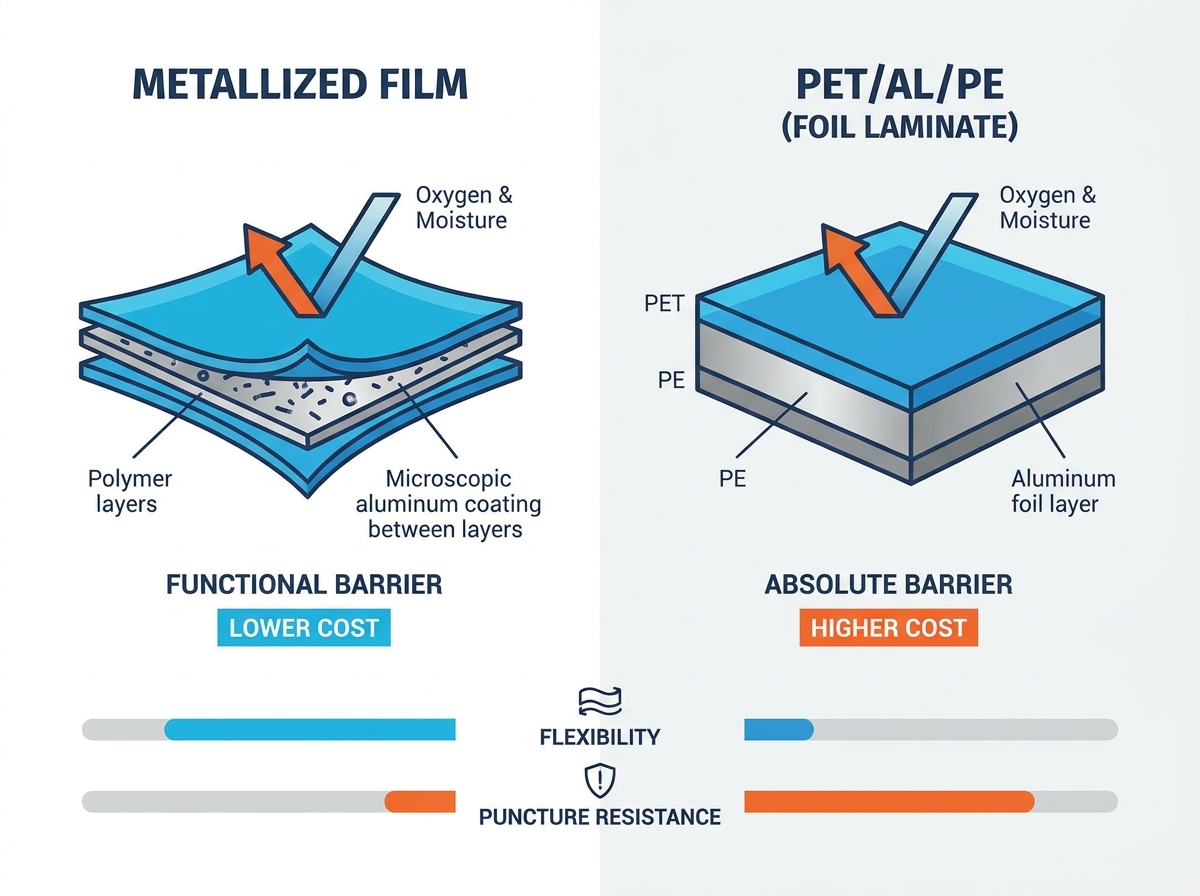
Transmission rates dictate shelf life. OTR measures how much oxygen passes through one square meter over 24 hours. WVTR measures moisture passage over the same period. Foil laminates deliver extraordinary numbers. They frequently approach an OTR of 0.01 cc/m²/day. They effectively stop all gas exchange. Conversely, a high-quality moistureproof oxygen-proof metallized film provides very strong, functional protection. Standard metallized OTR ranges typically fall between 0.5 and 1.5 cc/m²/day. For most dry foods, this transmission rate provides more than enough protection for a twelve-month lifecycle.
Both materials serve as excellent light blockers. Protecting against UV degradation prevents off-flavors. Solid foil provides absolute 100% opacity. Zero light penetrates a 7-micron aluminum sheet. Metallized films appear fully opaque to the human eye under normal lighting. However, they perform slightly differently. If you hold a metallized film against an intense backlighting source, you might notice microscopic pinholes. These tiny gaps in the vaporized coating allow trace amounts of light through. Despite this, the light barrier remains exceptional for retail environments.
Theoretical barrier limits mean nothing if the package breaks during shipping. Let us examine real-world distribution risks.
Foil Risk (Flex-Cracking): Aluminum foil possesses a distinct "dead-fold" characteristic. It holds tight creases perfectly. However, this rigidity creates a massive vulnerability. Foil is highly prone to micro-fractures during transit. Constant vibration causes flex-cracking. A single micro-fracture instantly destroys the absolute barrier.
Metallized Risk (Crazing): Metallized film handles mechanical flexing much better than rigid foil. The polymer substrate absorbs vibration. The metal coating bends without shattering. However, the film remains vulnerable to crazing if stretched aggressively. Excessive tension on a packaging line can compromise the metal layer.
Barrier Properties Comparison Chart
Performance Metric | PET/AL/PE Foil Laminate | Metallized Film (VMPET) |
|---|---|---|
OTR (cc/m²/day) | ~0.01 (Near absolute) | 0.5 - 1.5 (High functional) |
WVTR (g/m²/day) | ~0.01 (Near absolute) | 0.5 - 1.0 (High functional) |
Flex-Cracking Risk | High (Prone to pinholing) | Low (Absorbs vibration) |
Light Opacity | 100% Absolute | ~98% Highly reflective |
Packaging budgets dictate final decisions. Foil laminates are substantially more expensive. The raw material costs for solid aluminum remain high. Furthermore, foil structures weigh significantly more than polymer alternatives. This extra weight increases shipping and storage costs. Metallized films offer a powerful financial alternative. You receive a much higher yield per roll. The lightweight nature of the film reduces incoming freight costs. The cost-to-performance ratio heavily favors metallized structures for standard consumer goods.
Your packaging machinery dictates how well these materials perform. Vertical Form Fill Seal (VFFS) and Horizontal Form Fill Seal (HFFS) lines handle films differently. Metallized films generally allow for faster running speeds. They require lower sealing temperatures. The heat penetrates the thin polymer layers quickly. This improves your overall throughput.
Foil presents distinct operational challenges. Running heavy foil structures requires exact precision. You must carefully manage web tension limits. If the tension spikes, the rigid foil can snap or misalign. The heavy mass of the metal also demands longer thermal dwell times. The sealing jaws must apply heat longer to penetrate the solid aluminum layer. This requirement inherently slows down your production speed.
Direct food contact safety remains non-negotiable. Both packaging styles utilize a Polyethylene (PE) sealant layer. This inner layer ensures the dry food never directly touches the aluminum foil or the metallized coating. This design acts as a functional safety barrier. You must ensure all components meet strict regulatory standards. Every adhesive layer and resin batch must comply with FDA (21 CFR) requirements in the United States. In Europe, they must meet EU (10/2011) standards. Trustworthy suppliers provide comprehensive compliance certification before you begin any production run.
Certain products demand uncompromising protection. You must specify thick foil laminates when handling ultra-sensitive formulations. These products require maximum defense against oxygen and moisture over long periods.
Multi-Year Storage: Products requiring an 18 to 24-month shelf life need solid foil.
Medical-Grade Powders: Nutritional powders require strict moisture prevention to avoid chemical degradation.
Infant Formula: Absolute safety and nutrient preservation make foil the only viable option.
Premium Coffee: Whole bean coffee packed with one-way degassing valves relies on foil to trap delicate volatile oils.
You should specify metallized structures for high-velocity retail goods. These products move quickly through the supply chain. They do not need two years of shelf life. They require functional, cost-effective protection.
Standard Shelf Life: Products with a 6 to 12-month targeted lifecycle perform perfectly in metallized pouches.
Dry Snacks: Potato chips and extruded snacks rely on metallized film for moisture defense and crispness.
Pet Foods: Dry kibble utilizes metallized layers to prevent fat oxidation.
Dehydrated Foods: Standard pastas and dried soup mixes benefit from the lightweight, flexible protection.
Never commit to a massive commercial run blindly. You must validate your material choice through rigorous testing. We recommend specific accelerated shelf-life testing. Place your filled packages into environmental chambers. Elevate the heat and humidity to simulate long-term storage quickly. Furthermore, you must conduct thorough drop-testing. Dropping filled boxes simulates rough transit conditions. This reveals how the film handles flex-cracking. Validate these metrics carefully before finalizing your procurement orders.
Selecting the ideal packaging barrier requires strategic compromise. When you evaluate metallized film vs foil packaging, you are ultimately balancing absolute barrier protection against budget constraints. You must also consider physical distribution realities. Solid foil provides unmatched lab metrics but struggles with mechanical flexing. Metallized film provides excellent practical protection while lowering costs and improving machine speeds.
Your next steps involve clear technical validation. We recommend consulting directly with a packaging engineer. Ask them to conduct a precise OTR/WVTR audit of your current packaging format. Compare your actual shelf life needs against your current material specs. Finally, request sample rolls from your supplier. Run these samples on your VFFS or HFFS machinery. Real-world line trials will confirm which material delivers the best operational yield for your dry food products.
A: No. While they offer excellent functional barriers for many foods, they cannot replicate the near-zero transmission rates of solid foil. Ultra-sensitive items or multi-year shelf-life products still require solid aluminum laminates.
A: Foil laminates require higher thermal transfer times. Heat must penetrate the solid metal layer entirely. Metallized films seal much faster. They utilize slightly lower temperatures. This improves overall line speeds and reduces energy consumption.
A: Both are notoriously difficult to recycle in standard municipal streams because they combine distinct material families. However, new mono-material metallized options are emerging. Some metallized PE structures now allow for mechanical recycling in specialized facilities.
A: Yes. The micro-layer of aluminum in metallized films will trigger standard metal detectors. Packaging lines must use X-ray inspection systems instead. Alternatively, you can perform metal detection on the bare product before it enters the pouch.


