
close
Choose Your Site
Global
Social Media


Views: 0 Author: Site Editor Publish Time: 2026-10-05 Origin: Site


HVAC system efficiency and building code compliance rely heavily on the integrity of the insulation seal. Minor adhesive failures lead to significant energy loss and frustrating callback costs. Contractors and facility managers face a critical decision. They must choose between traditional foil tape and increasingly adopted linerless formats. Every project presents unique challenges. Your choice directly affects project timelines, safety, and operational workflows. Proper material selection prevents costly rework and protects your professional reputation. We created this article to provide an objective framework for evaluating both tape types. You will discover how to assess labor efficiency, application environments, and handling realities. We break down the mechanical differences between lined and unlined options. You will also learn specific best practices for surface preparation and pressure application. Read on to master tape selection and guarantee a reliable, long-lasting HVAC seal.
Efficiency vs. Precision: Linerless tapes drastically reduce job site waste and application time, while release-liner tapes offer superior handling control for precise, pre-cut applications.
Application Matching: Continuous pipe wrapping favors linerless, whereas complex, tight-clearance duct intersections often require the controlled application of a lined tape.
Preparation is Universal: Regardless of the liner format, proper surface preparation and verifiable pressure application are non-negotiable for system longevity.
Compliance Matters: Both tape formats must meet specific industry standards (e.g., UL 181) to pass inspection in commercial and residential HVAC applications.
Tape selection directly impacts your daily labor expenses and project profitability. Installation crews spend precious time cutting strips, peeling paper backings, and cleaning up job site waste. Poor material choices also drastically increase your long-term liability. Minor seal failures cause pressurized air to escape. This leakage forces HVAC equipment to work harder. The resulting energy loss angers building owners and triggers expensive callback repairs.
Many DIY enthusiasts and novice installers fall into a dangerous baseline trap. They attempt to use standard cloth-backed duct tape for HVAC insulation tasks. This choice inevitably leads to a complete system failure. Standard duct tape degrades rapidly under intense thermal cycling. Metal ductwork expands and contracts as hot and cold air flows through the system. These extreme temperature fluctuations cause traditional rubber adhesives to dry out completely. The cloth tape shrinks, cracks, and eventually falls onto the floor. HVAC systems demand a highly specialized solution. You need robust aluminum foil tape to handle extreme temperatures and resist degradation.
What exactly does a successful tape application look like? It requires a completely airtight seal across all seams and joints. You also need excellent moisture resistance to prevent condensation buildup inside the insulation. Thermal stability ensures the adhesive bond survives harsh seasonal temperature shifts. Finally, the chosen material must promote efficient labor utilization. Crews should apply it quickly, reliably, and safely under tight project deadlines.
Let us examine the traditional and most widely recognized approach. Manufacturers produce aluminum foil tape with release liner for a broad variety of sealing applications. This classic design features a protective layer positioned directly over the adhesive. Installers must manually peel away this silicone-coated paper or film backing right before application.
Handling Control: Installers can pre-measure and cut highly precise lengths. You can easily maneuver these pre-cut strips into extremely tight spaces. Installers frequently navigate cramped attics, narrow crawlspaces, and complex duct intersections. The adhesive remains perfectly protected until you are ready to remove the backing.
Zero Self-Adhesion Risk: Exposed tape strips sometimes fold over during handling. An exposed adhesive will aggressively stick to itself, rendering the strip useless. A release liner completely eliminates this frustrating scenario. You avoid wasting ruined materials before making the final placement.
Labor Inefficiency: Peeling the liner adds several seconds to every single application step. This tiny delay seems insignificant on a small residential repair. However, it compounds massively on large-scale commercial jobs. Crews lose valuable hours to repetitive peeling and handling tasks.
Job Site Waste: The peeled backing generates static-prone paper or film waste. This lightweight debris scatters easily and clutters the workspace quickly. It introduces slip hazards on smooth floors. It also requires dedicated cleanup time at the end of every shift.
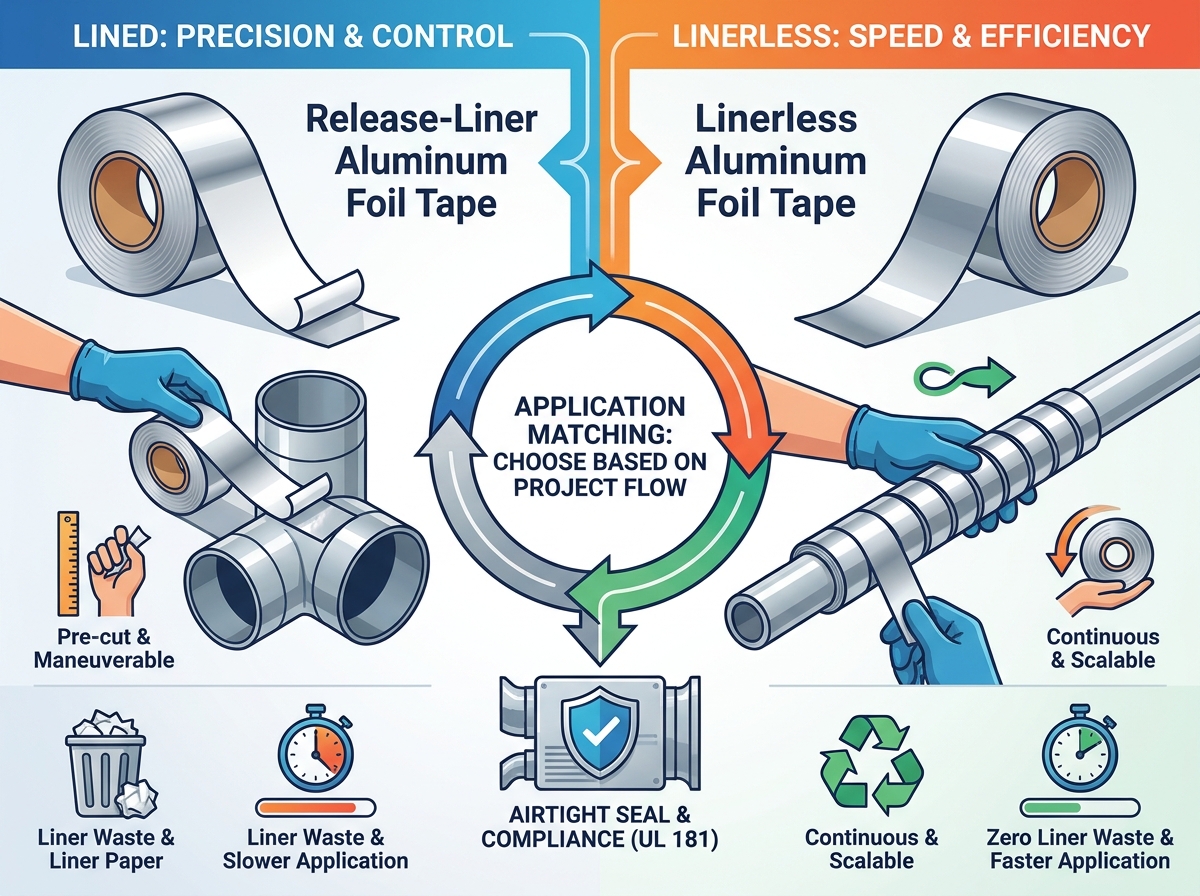
Manufacturers recently developed a highly efficient alternative to traditional formats. Engineers designed linerless aluminum foil tape to solve major productivity bottlenecks on job sites. Professionals in the industry also call it aluminum foil tape without liner or liner free aluminum foil tape. The clever engineering relies on a specialized silicone release coating. Factories apply this microscopically thin coating directly to the top side of the foil layer. This manufacturing innovation allows the tape to wind directly onto itself. It requires no intervening paper liner to separate the layers on the roll.
Speed and Scalability: This format enables a rapid, continuous application process. Eliminating the peeling step significantly speeds up your daily installation workflows. It performs exceptionally well on large, unobstructed duct runs where workers can move quickly.
Waste Elimination: Zero liner waste translates to an immediately cleaner job site. It creates a safer, hazard-free environment for other trades working nearby. Furthermore, it requires absolutely zero cleanup time at the end of the day.
Ideal Use Cases: Top contractors strongly prefer linerless aluminum foil tape for pipe wrapping. Securing insulation around long chilled water lines requires continuous spiral wrapping. Installers can easily maintain their wrapping rhythm. They never have to pause, peel, and discard paper strips.
Handling Difficulty: The constantly exposed adhesive poses a slight learning curve. Once you pull it from the roll, it can accidentally grab nearby objects. It might stick to the user's gloves, hand tools, or even twist onto itself. Installers need brief practice to handle it smoothly.
Tear Characteristics: Some backing thicknesses complicate the manual tearing process. You might need a specialized hand dispenser or a sharp utility knife to achieve a clean cut. Snapping a lined tape by hand is often much easier and cleaner.
You must evaluate specific project variables objectively before making a bulk purchase. We encourage buyers to weigh these practical trade-offs carefully. Avoid declaring one format universally superior to the other. You should always match the material to your specific task requirements.
Different HVAC projects demand drastically different installation approaches. Use a lined option for custom duct fabrication in a sheet metal shop. It also excels in residential repairs or intricate plenum transitions. You gain the control necessary for precision work.
Conversely, you should use linerless foil tape for insulation on large commercial straight runs. Extensive pipe networks also benefit heavily from unlined efficiency. The sheer volume of material applied makes the speed advantage undeniable.
Weather conditions and physical locations heavily influence material handling success. High-wind environments present a particularly annoying challenge for installers. Precarious locations like commercial rooftops, scaffolding, or tall ladders favor lined materials. An errant gust of wind cannot catch an exposed adhesive strip and ruin it. You maintain complete handling control until you reach the final placement position.
Debris management protocols vary significantly across different commercial facilities. Some modern commercial clients mandate strict zero-waste job sites. Hospitals and clean rooms often enforce stringent debris management protocols. These heavily regulated environments strongly favor linerless options. Installation crews generate zero paper or plastic debris during the application process.
Tape Format Comparison Chart
Evaluation Criteria | Release-Liner Tape | Linerless Tape |
|---|---|---|
Project Complexity | Ideal for tight spaces and custom fits | Best for continuous runs and pipe wraps |
Application Speed | Slower due to repetitive peeling steps | Extremely fast continuous application |
Waste Generation | High static-prone paper or film waste | Zero waste generated on the job site |
Environmental Resilience | Excellent in windy or precarious locations | Vulnerable to strong winds during unwinding |
Proper application techniques guarantee HVAC system longevity. Even the highest quality, most expensive materials fail under poor installation practices. We outline essential steps to secure your investment and pass municipal inspections.
Your premium adhesive will never perform on contaminated surfaces. Dusty, oily, or wet ductwork repels the chemical bond instantly. You must wipe down the application area mechanically using an appropriate rag. Sometimes, mild degreasers are necessary for older commercial renovations. Drying the surface completely is an absolute requirement before applying any material.
Foil tapes utilize specialized pressure-sensitive acrylic or rubber adhesives. They require active, physical force to create a permanent, molecular bond. Lightly pressing the strip down with your palm is woefully insufficient. You must use a plastic squeegee or a dedicated smoothing tool. Firmly rubbing the surface activates the adhesive fully. This sweeping action also eliminates trapped air pockets that compromise the seal.
Successful HVAC foil tape installation requires strict adherence to local building codes. You must verify UL 181A-P (for rigid ducts) or UL 181B-FX (for flexible ducts) certifications before purchasing. Municipal building inspectors will aggressively check for these specific UL ratings. The absence or presence of a paper liner is completely irrelevant here. Code compliance remains a mandatory requirement for all formats and brands.
You now understand the mechanical and operational differences between these distinct formats. We provide a simple logic framework to guide your final procurement choice. Use these rules to streamline your purchasing process effectively.
Choose a lined format if your team prioritizes absolute precision. It perfectly suits inexperienced crews who require more setup time and margin for error. It also excels in tight, complex duct configurations where maneuverability is poor.
Choose a linerless format if you prioritize maximum application speed. It absolutely dominates continuous spiral pipe wraps and long straightaways. It also boosts profitability on high-volume commercial installations. Eliminating daily waste cleanup saves valuable labor hours and boosts your bottom line.
We highly encourage commercial buyers to request physical material samples. Test both formats directly on your active job sites. Let your actual installation crews evaluate the handling differences firsthand. Practical daily experience often reveals hidden preferences that management might overlook.
Review your upcoming project specifications carefully against these criteria. Browse our comprehensive product catalog to find fully UL-rated sealing solutions. You can easily request a custom quote or download detailed technical specification sheets. Our expert technical team is ready to assist your rigorous evaluation process.
Choosing between these two foil tape formats is a highly strategic operational decision. It is not a trivial debate about one format being universally superior. The right choice depends heavily on your specific operational workflows and labor dynamics. You must also consider the physical constraints of your project environments. Keep these final action steps in mind as you move forward:
Audit your typical project environments to identify complex versus continuous application zones.
Calculate your current daily cleanup hours to see if zero-waste formats will improve efficiency.
Train your installation crews on pressure-sensitive bonding techniques using proper smoothing squeegees.
Always verify UL 181 material certifications to guarantee seamless building inspection approvals.
Match the right material to the job to ensure a durable, airtight seal every time.
A: No. Standard cloth duct tape degrades rapidly under thermal cycling. The extreme hot and cold fluctuations cause traditional rubber adhesives to dry out, shrink, and peel off. You must use specialized aluminum foil tape. It guarantees thermal resistance, long-term longevity, and mandatory building code compliance.
A: "Furnace tape" is a generic consumer term. People often use it interchangeably with foil tape. Technically, any tape you apply to a furnace must meet strict high-heat requirements. It must be a specialized, high-temperature rated aluminum foil tape. Always ensure it carries the proper UL certifications.
A: Keep the roll close to the application surface at all times. Pull short, manageable lengths to maintain control. We strongly recommend using a dedicated tape dispenser designed for foil materials. A proper dispenser maintains tension and provides clean cuts. This prevents the exposed adhesive from twisting.
A: Linerless tape is generally the preferred choice for pipe wrapping. It allows the installer to continuously wrap the material around the pipe circumference. You maintain a steady rhythm without stopping to peel and discard a paper liner. This efficiency drastically speeds up large-scale insulation projects.


