
close
Choose Your Site
Global
Social Media


Views: 0 Author: Site Editor Publish Time: 2026-05-31 Origin: Site


Modern engineering demands absolute reliability in zero-tolerance environments. Moisture, oxygen, or electromagnetic interference (EMI) can easily cause catastrophic product failure. You need materials engineered to prevent these exact risks. Aluminum Foil Laminated PET Film acts as a critical safeguard across multiple high-stakes industries. This composite structure marries the absolute barrier properties of solid aluminum foil with the mechanical toughness of polyester (PET) film. Pure foil often tears under stress, but adding a PET layer creates an unbreakable shield. This article serves as a technical and commercial evaluation guide. We will help procurement teams and engineers decide if this specific laminate is the exact solution for their stringent requirements. Read on to discover how its multi-layer anatomy outperforms conventional alternatives and secures your supply chain.
Ultimate Barrier: Achieves near-zero Oxygen Transmission Rate (OTR) and Water Vapor Transmission Rate (WVTR), outperforming standard metallized films.
Structural Synergy: PET provides necessary tensile strength and flex-crack resistance to the otherwise brittle 7-micron aluminum foil.
Application Specificity: The default choice for high-stakes food packaging, cold chain insulation, and electronics shielding where failure carries high financial risk.
Cost vs. Performance: Represents a higher investment than vacuum-metallized PET, justified only when absolute impermeability and mechanical durability are non-negotiable.
Engineers often face a distinct challenge when designing flexible barriers. You want the highest possible protection against the elements. Pure aluminum foil seems like the obvious choice. However, the physical reality of the material complicates matters.
Pure aluminum foil stands as an unmatched barrier against light, moisture, and gases. Flexible packaging usually relies on a standard foil thickness of roughly 7 microns. At this microscopic thickness, the metal becomes incredibly vulnerable. It suffers heavily from a phenomenon known as "flex-cracking." Folding or creasing the foil creates micro-tears along the stress lines. These invisible pinholes instantly compromise the barrier. Pure aluminum also lacks heat-sealability. You cannot melt it to form a secure pouch or bag without destroying the metal.
Manufacturers solve these physical limitations through structural lamination. They bond different materials together to create a synergistic composite. The standard laminate construction relies on a proven "Four-Layer" framework. Each layer serves a highly specific mechanical purpose.
Outer Layer (PET): This polyester film usually ranges from 12µm to 36µm in thickness. It provides a printable surface and exceptional puncture resistance. It also acts as non-conductive electrical insulation.
Adhesive Layer: This chemical layer permanently bonds the dissimilar substrates together. Industrial tapes often use colored adhesives or high-tack acrylic formulations here.
Barrier Layer (Aluminum Foil): This acts as the core defense mechanism. The solid metal sheet completely blocks light, moisture, and migrating gases.
Inner Layer (Optional): Manufacturers customize this layer based on the final application. They apply Low-Density Polyethylene (LDPE) to enable heat-sealing in pouches. Alternatively, they use a 50# release liner for die-cut industrial tapes.
Best Practice: Always specify the exact thickness of your PET outer layer. Thicker PET improves tensile strength but reduces the overall flexibility of the finished laminate.
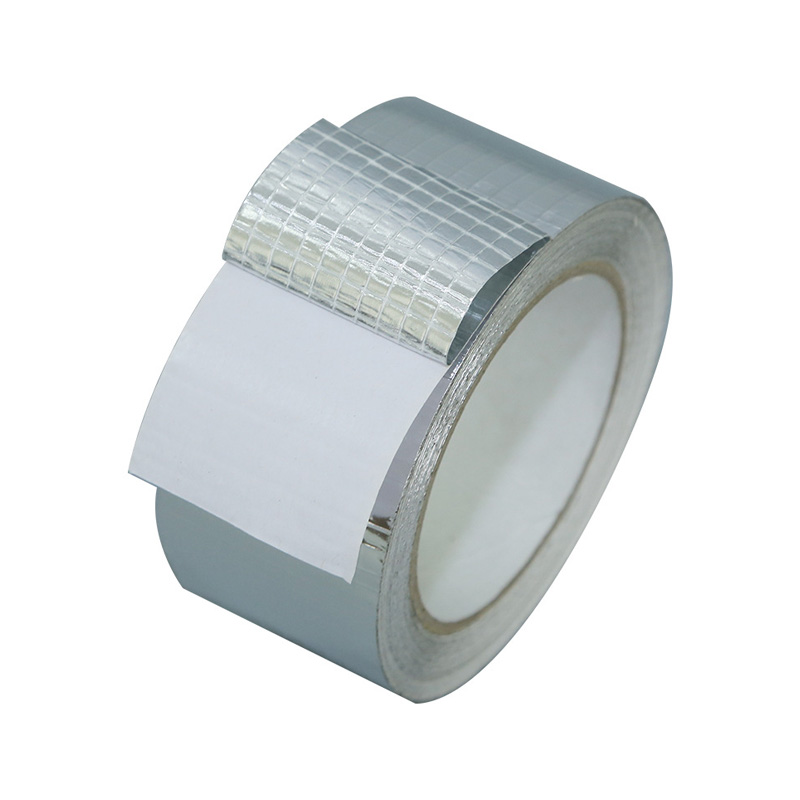
Procurement teams frequently confuse aluminum foil laminates with metallized PET (PET-met). They look identical to the naked eye. Both feature a shiny, silver finish. However, they perform entirely differently under stress. Understanding this difference prevents costly specification errors.
The core physical difference lies in the manufacturing process. Laminates bond a solid, continuous sheet of aluminum foil to the PET film. You get a true metal barrier. PET-met uses a completely different approach. Manufacturers place a plastic roll inside a vacuum chamber. They vaporize pure aluminum and let it condense on the film. This deposition process uses only about 1% of the metal found in solid foil. It creates a microscopically thin coating rather than a solid sheet.
When you look at the raw data, the performance gap becomes obvious. You must evaluate these materials based on their transmission rates and chemical tolerances.
Performance Metric | Aluminum Foil Laminate | Metallized PET (PET-met) |
|---|---|---|
Oxygen Transmission Rate (OTR) | ≈ 0 cc/m²/day | 0.5 – 5 cc/m²/day |
Water Vapor Transmission Rate (WVTR) | ≈ 0 g/m²/day | < 0.5 g/m²/day |
Flexibility & Weight | Heavier, prone to creasing | Ultra-light, highly flexible |
Pinhole Risk | Low (if laminated correctly) | High (inherent to vacuum process) |
Aluminum laminates achieve near-zero OTR and WVTR. They offer absolute impermeability. PET-met inherently suffers from microscopic pinholes. Its OTR hovers between 0.5 and 5 cc/m²/day. This slight permeability allows gases to slowly migrate over time.
Chemical environments complicate material selection. PET-met generally handles highly acidic, alkaline, or salty environments better than bare foil. Bare aluminum corrodes quickly when exposed to harsh salts or acids. However, laminates easily overcome this weakness. Manufacturers fully encapsulate the aluminum foil between layers of inert PET and PE. This encapsulation protects the metal from direct chemical exposure.
You must acknowledge the commercial trade-offs. Laminates remain highly energy-intensive to produce. The bonded dissimilar materials make them incredibly complex to recycle. They represent a higher initial investment. This makes them completely unsuitable for low-margin, short-shelf-life goods.
You should choose PET-met for everyday snacks and basic insulation. The lower cost and weight make sense for quick-turnover items. You must mandate solid aluminum laminated PET for mission-critical applications. Surgical equipment, long-term survival rations, and heavy-duty telecom cables demand absolute failure prevention. If a compromised barrier ruins the product, you must use the solid laminate.
Understanding the material properties helps you pinpoint its best use cases. This specific laminate dominates several major industrial sectors. Each sector leverages a different aspect of the multi-layer structure.
The food industry relies heavily on food packaging solutions to extend shelf life. Oxygen exposure directly equals rapid spoilage. You see this laminate used extensively in retort pouches. These pouches must withstand intense heat during sterilization without melting or bursting. Sterile liquid packaging also depends on this absolute barrier. A single pinhole could introduce bacteria and ruin an entire batch of liquid nutrition. The foil layer blocks out oxygen and UV light, preserving complex flavors and preventing fat oxidation.
Modern telecommunications require pristine signal clarity. Interference causes dropped data and equipment malfunction. Engineers use this laminate for critical electronics shielding in structured cabling networks. It plays a dual role. The solid foil layer acts as a Faraday cage. It aggressively blocks electromagnetic interference (EMI) and radio frequency interference (RFI). Simultaneously, the PET layer provides a non-electrical conductive backing. This prevents the foil from creating unintended short circuits when wrapped tightly around internal wires. You will find this material in heavy-duty Ethernet cables, aerospace wire harnesses, and sensitive equipment grounding straps.
Temperature control requires aggressive thermal management. In cold chain logistics, fluctuating temperatures destroy sensitive pharmaceuticals and biological samples. The foil layer offers tremendous radiant heat reflection. It bounces external thermal energy away from the cargo. Furthermore, it acts as an absolute moisture barrier. This prevents destructive condensation buildup during long transit routes. The construction industry applies the exact same logic. Builders wrap HVAC ventilation ducts with this laminate. The material prevents moisture from penetrating the insulation fiberglass, which stops mold growth and maintains energy efficiency.
Common Mistake: Never use a purely metallized film for exterior HVAC ducting. The thin vaporized aluminum will rapidly degrade under continuous environmental stress and moisture exposure.
Buying technical composites requires precision. You cannot simply order a generic roll and expect perfect performance. Procurement teams must define their requirements using strict engineering tolerances. Small variations in manufacturing can cause massive failures on your production line.
Your converting machinery dictates the physical dimensions you must order. Buyers should demand strict dimensional accuracy from their suppliers. Standard manufacturing capabilities usually offer roll widths ranging from 5mm all the way to 1600mm. You must also specify the correct roll core ID (Inside Diameter). Standard converting machines typically require either a 53.5mm (2.1-inch) or a 76mm (3-inch) core. The wrong core size means the roll will not fit onto your automated unwinding shafts.
Aluminum foil comes in different metallurgical states. We call this the "temper" of the metal. For cable wrapping or wire harness applications, you must specifically request a "Soft" temper aluminum. Soft temper metal exhibits dead-fold characteristics. It bends and stays bent. This ensures tight, flush wrapping around the cables without any annoying rebound or unwinding. A "Hard" temper foil will continuously try to spring back to a flat state, destroying your cable wrap.
Industrial tape and shielding applications rely heavily on the internal adhesive layer. If the adhesive fails, the entire laminate delaminates. You must evaluate the adhesive performance using standard metrics. Highlight these two specific values during procurement:
Peel Strength: Look for a minimum rating of roughly 50 oz./inch. This ensures the tape aggressively bites into the substrate.
Tensile Strength: Demand a rating near 6,000 P.S.I. This prevents the tape from stretching and snapping under mechanical tension.
Never place a bulk order without verifying supplier testing protocols. Quality assurance separates reliable partners from risky vendors. Advise your engineering team to request physical test reports. You need to see data on flex-cracking limits. How many folding cycles can the laminate survive before pinholes appear? Additionally, demand testing data on interlayer bond strength. Weak lamination causes the PET and aluminum to separate during automated cutting or winding. Always request sample rolls to test compatibility with your specific machinery before committing to a full production run.
Verify Exact Material Thickness (e.g., 12µm PET + 7µm Foil).
Confirm Roll Width and Core ID specifications.
Specify Foil Temper (Soft vs. Hard).
Require TDS (Technical Data Sheet) highlighting Peel & Tensile Strength.
Request independent lab reports for WVTR and OTR testing.
Aluminum Foil Laminated PET Film remains the heavy-duty standard for applications requiring absolute barrier protection combined with mechanical resilience. Pure aluminum delivers the ultimate shield against moisture, gases, and electromagnetic interference, while the PET layer ensures the structure survives harsh physical handling. You simply cannot achieve this level of reliability with vacuum-metallized alternatives. When product failure carries massive financial or safety risks, this composite structure provides guaranteed peace of mind.
Your next step requires careful evaluation. Review your project requirements to determine the exact OTR and WVTR specifications you need. Cross-reference these numbers with your environmental stresses. Finally, reach out to verified suppliers to request Technical Data Sheets (TDS) and sample rolls. Testing the material on your own converting machinery ensures perfect compatibility before you scale up production.
A: AL-PET features a single layer of aluminum bonded to PET. AL-PET-AL is a sandwich structure with foil on both sides. The double-sided foil provides bi-directional mechanical shielding and specific electrical properties required for strict telecom requirements.
A: It is difficult to recycle due to the permanently bonded dissimilar materials (plastic and metal). Standard municipal facilities cannot process it. However, specialized industrial recycling facilities can separate and recover the components using chemical or thermal processes.
A: The AL/PET structure alone cannot be heat-sealed. The PET and aluminum will burn or warp before forming a bond. To achieve a heat seal, you must add a thermoplastic layer, typically LDPE (Low-Density Polyethylene) or CPP, onto the inside face.
A: Yes. The composite nature interacts with flammability standards. PET is a plastic and can melt or burn. If you use this material in HVAC ductwork, you must necessitate specific fire-retardant adhesives and coatings to meet strict building fire codes.


